Get Full Government Meeting Transcripts, Videos, & Alerts Forever!
Get email alerts on the Event Center Noise topic
No spam. Unsubscribe anytime.
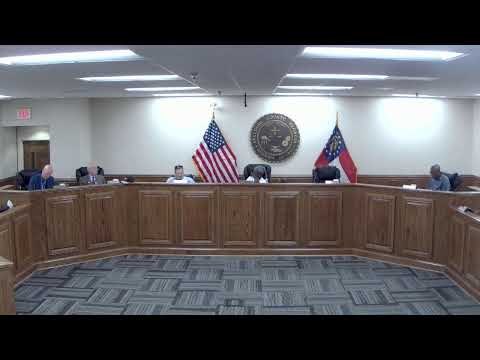
Spalding County commissioners debate event‑center noise rules, direct staff to rewrite ordinance
Summary
At a July 21 special meeting the Spalding County Board of Commissioners discussed revisions to an event‑center/amplification ordinance — including a proposed 100‑foot audible test — and asked staff to return with a rewritten ordinance that focuses on property lines, defines "event center," and addresses bass/subwoofer noise and quiet hours.
Spalding County commissioners on July 21 discussed revisions to the county's event‑center and noise rules and directed staff to rewrite the proposed ordinance to focus on property lines, clearer definitions and quiet hours rather than the one‑size‑fits‑all 100‑foot audible test currently on the draft.
The discussion grew out of a staff draft that would exempt an approved event center from obtaining an amplification permit provided a permanent marker is placed 100 feet from the exterior wall, the marker is documented by a certified land surveyor and the marker's location is registered with Spalding County code enforcement. County Manager David (who presented the draft) said under the proposal "if two law enforcement officers determine that the sound is not audible at the 100 foot marker using unaided human hearing, the event may proceed without interruption. If the sound is audible at the 100 foot marker, the event shall be immediately ended and a citation issued to the event center." The draft also said repeated violations (more than twice within a 12‑month period) would require the center to return to monthly amplification permits.
The board and speakers at the workshop questioned whether measuring audibility at 100 feet from a building is practical for indoor venues, outdoor pavilions and large rural properties. Commissioners and members of the public raised enforcement and fairness concerns: how to measure bass or subwoofer vibrations, how to account for road and truck noise when using decibel meters, whether markers should be on the property line rather than a fixed distance from a building, and whether quiet hours should apply to event centers the same as to residents.
Why this matters: the change would create a distinct set of rules for businesses that host frequent public events (event centers) and could alter enforcement and permit burdens for venues and nearby residents. Commissioners framed the issue as balancing residents' right to quiet with businesses' interest in operating without undue regulatory hardship.
Details of the staff draft and board concerns David summarized the draft ordinance's key provisions: a permanent visible marker 100 feet from the building, surveyor documentation, registration with code enforcement and an enforcement test based on unaided human hearing at that marker. He said the draft is meant to "streamline the process" for approved event centers by removing the need to apply for an amplification permit for each event so long as the marker/audibility test is met.
Commissioner Flowers Taylor and other commissioners said the county needs a clear definition of "event center" and to know how many such facilities exist. Several commissioners and business owners noted multiple facilities operate across the county in different zoning contexts (indoor halls, pavilions, venues in shopping centers or commercial parcels versus rural properties).
Measuring point: 100 feet from the building vs. property line Several commissioners and speakers said the 100‑foot marker concept is arbitrary for many venues and can produce inconsistent results depending on which wall or which side of a building is tested. Commissioner James Dutton, among others, suggested using the property line as the measuring point rather than a fixed distance from a wall. Business owners said staking large rural properties could be onerous; one owner suggested a geofence or an alternative to full land surveys.
Decibels, bass and enforcement Speakers pressed practical issues around enforcement. Several commissioners pointed out that decibel meters pick up ambient sounds such as truck traffic and that different meters give different readings. Commissioners repeatedly identified low‑frequency bass (subwoofers) as the primary community concern because bass "travels" and rattles windows even when the music itself is not clearly audible. As one commissioner put it during debate, "if you can feel it in your chest, that's an issue." Several commissioners favored a standard that focuses on disturbance at a neighbor's property rather than strict audibility at a fixed perimeter marker.
Comments from venue operators and nearby residents Coley Wayland, identified in the meeting as one of the owners of Mystic Acres, said the business supports limiting music so it does not travel off the property but objected to the 100‑foot fixed test for venues with dozens of acres. Wayland said, "we fully support the intent to not have music travel outside our property boundaries," and described steps Mystic Acres has taken, including adding foam bass traps in corners and closing doors promptly.
Curtis Platt, who said he owns Shoal Creek/Griffin Country Club, argued for property‑line measurement as a practical standard: "I firmly believe that the property line is the right way to go," he said, noting that some venues operate on far larger parcels where a 100‑foot line would not reach the parking area.
A nearby resident, Tracy Manis, said her retired parents live close to Mystic Acres and that bass has rattled windows and disrupted sleep. Manis said the family had spent money adding soundproofing and urged the county to set a curfew: "My mom and dad... deserve the peace to be able to live out the rest of their days without having to hear noise," she said, and recommended a 10 p.m. cutoff as a fair compromise used by many wedding venues.
Board direction and next steps Commissioners did not adopt the draft ordinance at the meeting. Instead they directed county staff (David and Stephanie) to revise the proposal, with guidance to: - define "event center" and identify which existing facilities would qualify; - favor property‑line‑based measurement or otherwise craft a clear, enforceable perimeter standard rather than the single 100‑foot marker from a building wall; - address low‑frequency bass/subwoofer limits or mitigation (for example, contract terms, bass suppression measures and on‑site enforcement authority); - clarify how quiet hours (board members discussed 9 p.m. as a commonly used quiet hour) and permit thresholds (for example, when outside amplification or multi‑hour events require county notice/permit) will apply to commercial event centers versus private one‑time events; and - continue stakeholder outreach (Mystic Acres, Shoal Creek/Griffin Country Club and other operators and adjacent residents) before the board sees a revised draft.
The chairman closed the discussion by asking staff to return with a cleaner, less vague draft and to circulate it to affected businesses and neighbors for comment before the board's next review. The meeting adjourned by motion at the end of the session.
Next steps: staff will draft a revised ordinance and return to the board; commissioners asked staff to give venue owners a chance to review and comment on the rewrite before the board considers formal adoption.