Get Full Government Meeting Transcripts, Videos, & Alerts Forever!
Get email alerts on the Affordable Housing Zoning topic
No spam. Unsubscribe anytime.
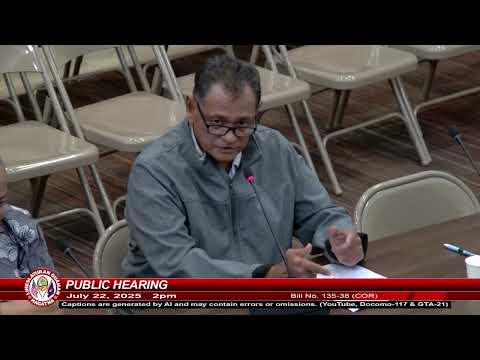
Committee hears Affordable Housing Streamlined Zoning Act; agencies recommend amendments on sewer, timelines and staffing
Summary
The committee held public testimony on an Affordable Housing Streamlined Zoning Act (referred in testimony as bill 164-38), with sponsors and housing advocates urging faster rezoning to meet housing demand and agencies urging amendments to protect the Northern Guam aquifer, require sewer connections or suitable wastewater systems and to fund technical staffing.
The committee heard sponsor testimony and extensive public comment on the Affordable Housing Streamlined Zoning Act (referred in testimony as bill 164-38 (transcript references 160-438 COR / 164-38)). Sponsors and housing advocates said the bill would shorten rezoning timelines for projects targeting low- and moderate-income households, while agencies urged amendments to protect water resources and to build administrative capacity.
Sponsor Senator Tina Rose Munia Barnes read a statement emphasizing a 10-year land-use restriction to keep housing affordable and said the bill “strikes the right balance between cutting red tape and maintaining…protections for our aquifer and critical resources.” The sponsor framed the bill as a response to an escalating housing shortage and invited legislative support for faster, accountable pathways to build affordable units.
Micronesia Community Development Corporation (represented by Carlos Camacho) testified in strong support and described how timing affects eligibility for time‑sensitive funding sources such as low‑income housing tax credits and other grant programs. Camacho asked the committee to consider increasing the bill’s ten-year land-use restriction to 15 years to align with federal underwriting and tax‑credit program timing.
Guam EPA and the Bureau of Statistics and Plans (BSP) supported the bill’s intent but requested changes. Guam EPA recommended that zone changes not be allowed on unsewered properties within the designated groundwater protection zone and said where municipal sewer is not available, developers should install “advanced nitrogen reducing on-site wastewater disposal systems” only for single-family R1 lots (not for apartment buildings or subdivisions). An EPA witness said the agency has no objections to sewered properties or sites outside the groundwater protection zone but urged stronger safeguards and enforcement language.
BSP urged clarifications on the role of the Agency Review Committee (ARC) and on timelines. BSP recommended conditional extensions to the proposed 30-day technical review deadline, said its current staffing could make the 30-day turnaround infeasible for complex cases, and suggested funding for additional personnel to avoid compromising technical review quality. BSP also flagged statutory inconsistencies between the bill’s proposed fast‑track municipal planning council procedures and existing municipal hearing requirements in 21 GCA chapter 61, and recommended aligning the statutory language.
The Department of Land Management (DLM/GLUC executive secretary) described where perceived “zoning delays” come from and urged the committee to identify specific procedural bottlenecks, especially municipal public‑hearing scheduling and the multi‑stage notice process. DLM recommended targeting the municipal public‑hearing requirements and other administrative steps rather than broadly applying expedited rules to every application.
Stakeholders including the Guam Association of Realtors and nonprofit developers urged passage to speed up affordable housing production but acknowledged the need for environmental and procedural safeguards. Committee members requested financial impact statements for additional staffing and agreed to work with agency authors to refine timelines and safeguards.
The bill received sponsor statement and public testimony; committee members said they will consider amendments on sewer connection requirements over aquifer areas, the length of land‑use restrictions, 30‑day review timelines and resourcing for BSP and ARC technical review. No final committee vote was recorded during the hearing.