Lifetime Citizen Portal Access — AI Briefings, Alerts & Unlimited Follows
Committee hears contested unsolicited solar proposal for GICC land; developer absent, environmental and trustee concerns raised
Loading...
Summary
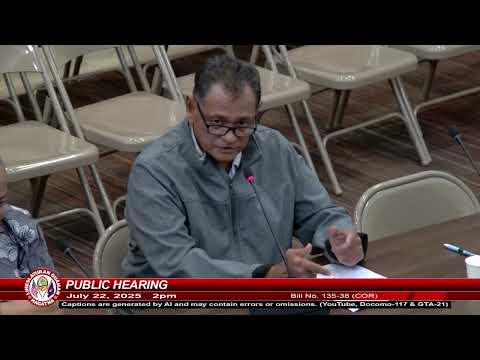
The committee on General Government Operations and Appropriations held a public hearing on an unsolicited proposal to build utility-scale solar panels on land now occupied by the Guam International Country Club (GICC), with senators, EPA staff and public witnesses pressing environmental, procurement and benefit-to-beneficiary questions while the primary developer did not remain to answer questions.
The committee on General Government Operations and Appropriations held a public hearing on an unsolicited proposal to develop utility-scale solar panels on land currently occupied by the Guam International Country Club (GICC), drawing questions about process, environmental risk and benefits to Chamorro Land Trust beneficiaries.
Senators and public witnesses pressed the absence of the developer at the hearing. Senator Trelahi asked, “Is he here, mister chair?” and said the proposal had been submitted to the land trust without the usual public bid process. Committee members and multiple witnesses said developer representatives declined to remain for questions or had already left the hearing.
Public testimony described competing visions for the site. Testifier Robert (last name in transcript: Celestial) said the property had previously generated revenue for community programs and urged reclaiming the site for Chamorro Land Trust use: “If you get a golf professional, an individual who understands management in golf...the proceeds could go to the Chamorro Land Trust.” He also proposed relocating Chamorro Land Trust offices to the site and using existing rent payments ($896,000 referenced in testimony) to fund infrastructure.
Committee members sought technical and contractual details. Senator Trelahi asked whether the developer had told municipal planners that the project would lower consumer electric rates; a committee witness said the Guam Power Authority (GPA) will lower rates through broad procurement of solar regardless of this single contract, and that the legislature previously passed a renewable energy policy guiding GPA procurement.
Environmental concerns and disposal were raised by Guam EPA staff. An EPA representative said there are “consequences and… hazards associated with solar panels in their manufacturing and also with their disposal” and cited an example from Typhoon Mawar when residential panels were handled as hazardous waste in 40-foot containers. EPA said the landfill will not accept hazardous solar waste and that disposal is the developer’s responsibility.
Committee members also questioned the proposal’s financing and structure. A proponent’s representative (Camacho) described a roughly $300,000,000 total development cost and said the developer had proposed phasing (parcel sizes disclosed in testimony as 26.4, 26.4 and 4.4). Camacho identified a local partner, Power Solution, and said two local owners are involved alongside an international partner (SK Eco Plant, noted as a Korean company in testimony). Senators asked whether local subcontracting was planned; Camacho said none was confirmed at that time.
Several senators and witnesses urged a formal competitive bid process instead of approving an unsolicited deal. Senator Tydiguo and others said the public and Chamorro Land Trust beneficiaries deserve a transparent procurement and that if a solar deal is pursued, the value returned to Chamorro Land Trust beneficiaries should be maximized.
The committee recorded that bill number 130-538 COR (the related measure referenced during this portion of the hearing) “has been publicly heard” and moved on to the next agenda item. Committee staff said written statements would be accepted for seven days following the hearing.
The hearing produced no recorded final vote on the proposal; committee members left open requests for additional documentation (sewer plans, investor and subcontractor lists, precise financial terms) and noted the developer’s absence as a material barrier to answering outstanding questions.