Get Full Government Meeting Transcripts, Videos, & Alerts Forever!
Get email alerts on the Economic Development topic
No spam. Unsubscribe anytime.
Weber County hears pitch to join Far West Landing CRA; commissioners ask for development agreement and safeguards
Summary
Far West City and a private developer asked Weber County on July 21 to join a proposed Community Reinvestment Area called Far West Landing and to participate in property-tax increment financing to help pay for public infrastructure.
Far West City and a private developer asked Weber County on July 21 to join a proposed Community Reinvestment Area called Far West Landing and to participate in property-tax increment financing to help pay for public infrastructure.
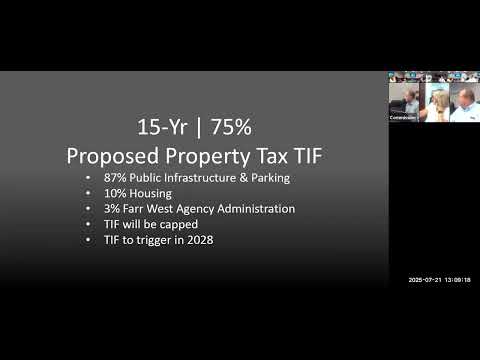
At a commission work session, Doug Larson, presenting for the development team, told commissioners the project area covers about 50 acres and that the city is proposing a 15-year participation term with a 75% county participation rate in the property-tax increment. "The city's asking for a 15 year term, 75% participation," Larson said during the presentation.
The Nut Graf: Commissioners and county staff said they are open to participation but want the development agreement between the city and the developer finalized first and want the county's participation agreement to include firm trigger dates, clawbacks and caps so the county is protected if the project does not meet milestones.
Larson and city staff provided the commission a package of estimates and commitments: a 2024 baseline valuation for the roughly 50-acre area of about $9.8 million; an estimated full-build real-estate valuation “just over $100 million;” an estimated property-tax increment of about $10.3 million over the TIF term; a city pledge of roughly $7 million in sales-tax rebates and about $947,000 in fee waivers; and transportation funding of about $5.4 million from WACOG to help build the road. The developer’s total development-cost estimate presented to the commission ranged roughly from $224 million to $230 million.
Speakers cautioned the commission to limit the county’s exposure strictly to infrastructure reimbursement. Commissioner Stephanie (last name not specified in the record) noted the county should not be participating in the sales-tax rebate; staff confirmed the county’s participation would be limited to property-tax increment. Commissioners repeatedly emphasized two contract safeguards they want reflected in any county participation agreement: a deadline/operating target tied to triggering the tax increment (the presentation said the TIF is expected to trigger in 2028 and that the development agreement requires an operating target by 2029) and a clawback/termination mechanism if the target is not met.
The presentation also described the CRA code requirement that 10% of tax increment be set aside for affordable housing. Based on the city’s and developer’s presented assumptions, staff said that housing set-aside was expected to be on the order of about $1.1 million over the TIF period. Larson described a tiered sales-tax rebate schedule (100% of the city’s sales-tax increment for the first five years, 85% for the second five years and 80% for the last five years) and said the city anticipates that tiered structure over 15 years; the presentation included both a $7 million sales-tax pledge and a later comment that the sales-tax structure “would generate $70,000,000,” an inconsistency the presentation did not reconcile.
Commissioners pressed on location and access, housing mix and the proportion of residential in what they said they view as a valuable freeway-front commercial corridor. Some commissioners welcomed the multifamily component as the city’s first apartment inventory in that area and said the 10% housing set-aside was useful for the city’s moderate-income housing goals; others said they prefer more of the freeway frontage be commercial rather than residential. Several commissioners said they want the county’s participation agreement to specify which improvements the county’s share will reimburse (for example, “our portion of the tax increment would only go towards the road,” staff said) and to include reporting and annual accounting requirements.
There was no vote or formal action at the work session. The commission directed staff to return with a proposed participation agreement that mirrors the development agreement’s deadlines and includes the requested trigger, cap and clawback language and reporting requirements. Commissioners and staff also agreed not to move to formal county participation until the city and developer finalize the development agreement.
Ending: County staff will draft a participation agreement for commission review and meet again after the city and developer finalize the development agreement; no final county commitment was made at the July 21 session.