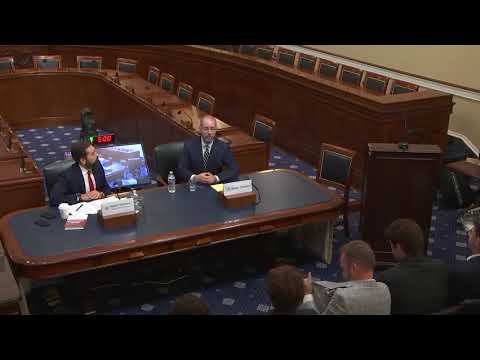
Presenter urges U.S. to use foreign-policy leverage to protect religious freedom worldwide
Get AI-powered insights, summaries, and transcripts
SubscribeSummary
A presenter argued that the United States should consistently press governments and nonstate actors to stop religious persecution, outlining four types of persecution and four policy tools — coalitions, consistency, call-outs and consequences — and citing examples including Rohingya, Uyghurs and Uzbekistan.
During a policy forum, a presenter urged U.S. policymakers to use diplomatic and economic leverage to defend religious freedom worldwide, saying the United States "is uniquely positioned" to help persecuted believers.
The presenter said the issue matters because of the scale of religious adherence and the scope of restrictions: "roughly 85% of the world believes in God or a higher power," and about "2 out of 3 people on earth live in environments that restrict the free practice of faith," conditions that the presenter described as a "recipe for instability."
In the talk, the presenter outlined four types of persecution: authoritarian (state-imposed penalties), extremist (nonstate mob or violent attacks), democratic majoritarian abuse (when a dominant religious community uses state power to enforce beliefs) and terrorism (organized groups using extreme violence). The presenter described persecution as a combination of violence and a lack of accountability, saying that where there is impunity "things can happen with impunity," which distinguishes persecution from isolated incidents handled by a rule-of-law system.
The presenter cited country examples discussed in a recent book: Burma and China in discussions of genocidal treatment of the Rohingya and Uyghurs; experiences in Georgia, Sri Lanka and Pakistan related to extremist violence and community-level persecution; India in the context of rising Hindu nationalism and its effects on Indian Muslims and Christians; and Iraq and Afghanistan with respect to ISIS-related displacement of religious minorities. The presenter referenced the case of Asia Bibi, described as "a Christian mother sentenced to death for alleged blasphemous activities," as an example discussed in Pakistan.
For policy tools, the presenter described the "four C's": coalitions (building cross-ideological alliances), consistency (raising concerns with both allies and adversaries), call-outs (publicly naming abuses to draw attention) and consequences (using policy levers when governments do not change). The presenter gave Uzbekistan as a concrete example, saying it had been "designated as a country of particular concern for 15 years or so" and that policy carrots and sticks helped prompt partial liberalization after leadership change.
The presenter specifically urged Hill staffers and congressional offices to use low-cost, targeted actions — such as sign-on letters — to secure individual releases and press foreign governments, saying such efforts were "a great use of staff time" and an "even better use of intern time." The presenter also named U.S. bodies that can amplify call-outs, mentioning the State Department and a "Religious Freedom Commission."
The talk was framed as discussion and recommendations rather than formal policy changes: no motions, votes or formal actions were proposed during the remarks. The presenter encouraged staff and policymakers to translate the four C's into sustained, credible pressure and to consider both public naming of abuses and calibrated consequences when governments fail to improve.
The presenter closed by emphasizing the human stakes: "there are literally millions of people every day that risk so much, really risk their lives just to pray how they want," and urged congressional staff and other officials to use their influence in follow-up work and Q&A sessions.