Get Full Government Meeting Transcripts, Videos, & Alerts Forever!
Get email alerts on the Economic Development topic
No spam. Unsubscribe anytime.
Wilsonville council backs staff to advance Coffee Creek land‑assembly plan
Summary
City staff briefed the council on a targeted land‑assembly strategy using Coffee Creek Urban Renewal funds and state RSIS reimbursement to bridge valuation gaps; council gave consensus to proceed with preparatory administrative work only.
Wilsonville officials agreed Monday to let staff continue administrative work on a proposed land‑assembly strategy aimed at accelerating industrial development in the Coffee Creek area.
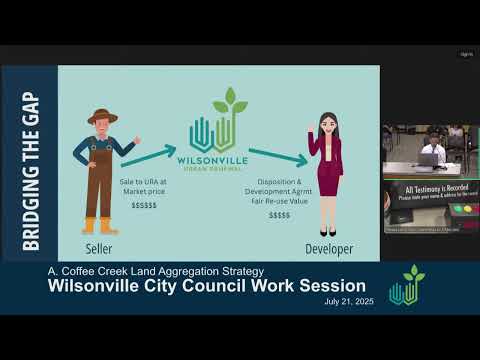
Economic development manager Matt Lorenzen told the City Council the Coffee Creek Industrial area has seen decades of intermittent efforts but only limited large‑scale development, and now faces three main barriers: fragmented parcel ownership, ‘sticky’ interim uses (gravel and contractor yards) that generate steady cash flow for owners, and a persistent valuation gap between what owners demand and what developers can afford. He proposed using the Coffee Creek Urban Renewal Agency to acquire adjacent parcels from willing sellers, assemble development‑ready sites and then issue disposition and development agreements to private developers.
Lorenzen said the city would not use condemnation or eminent domain, and that acquisitions would be from willing sellers only. He described a reimbursement path through Business Oregon’s Regionally Significant Industrial Sites (RSIS) program: the agency could cover a portion of the valuation gap up front using urban renewal funds and seek RSIS reimbursement after developers create jobs on the site. "This is all about folks that are willing to sell," Lorenzen said. He also told council that any land purchases or disposition would require subsequent council authorization.
The proposal would require several follow‑up steps if property opportunities arise: a minor amendment template to the Coffee Creek Urban Renewal Plan, an amendment to the city’s RSIS contract with the state to explicitly allow land assembly as an eligible reimbursable activity, and disposition and development agreements that pass risk to buyers where appropriate. Lorenzen said the Coffee Creek Urban Renewal area has a statutory maximum indebtedness of $67,000,000; roughly $5–7 million has already been spent on the Garden Acres Road project, he said, and proceeds from property sales are returned to the urban renewal fund and can be re‑spent.
Councilors asked about examples, risk and timing. Councilor Shevlin said incentives such as RSIS sounded like the mechanism she had in mind; Councilor Dunwell asked whether RSIS relied on federal funding and was told RSIS is funded with state lottery dollars; Councilor Cunningham noted the importance of targeting owner‑users rather than pure speculative buyers. Lorenzen repeatedly framed the approach as a measured, administrative step now to preserve options: if council directed staff to proceed, the immediate work would be limited to preparing agreements and processes rather than buying property.
At the end of the presentation, Lorenzen asked whether council wanted staff to proceed with preparatory work; council responded in the affirmative. The direction given was administrative only — additional property‑specific purchases or commitments would return to council for approval.
What happens next: staff will pursue a minor amendment to the RISIS contract, prepare a template minor amendment to the Coffee Creek Urban Renewal Plan to be used on a property‑by‑property basis, and keep the council informed if specific willing parcels become available.