
Wasilla council delays final vote on broad rewrite of Title 16 after adopting changes to short-term rental and landscaping rules
Get AI-powered insights, summaries, and transcripts
Subscribe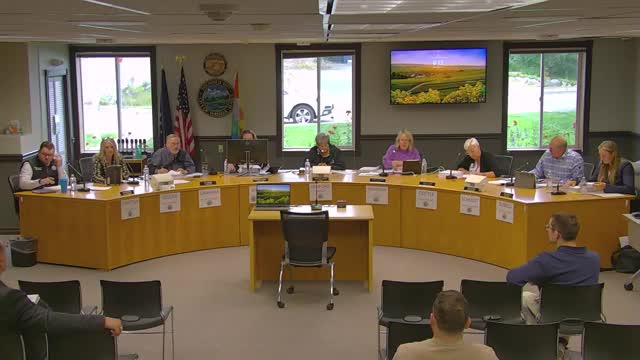
Summary
The Wasilla City Council on Monday postponed final action on Ordinance Serial No. 25-14 — a comprehensive repeal and reenactment of Wasilla Municipal Code Title 16 — after hours of debate and targeted amendments.
The Wasilla City Council on Monday postponed final action on Ordinance Serial No. 25-14 — a comprehensive repeal and reenactment of Wasilla Municipal Code Title 16 — after hours of debate and targeted amendments. Councilors approved several changes to the draft code, including scaled-back short-term rental rules and narrower landscaping requirements, and set a continuation for the council’s July 14 meeting.
Ordinance 25-14 would change permitted uses in zoning districts, review and permitting procedures, landscaping and parking standards, conditional-use and variance rules, planned unit development provisions and design standards. The council spent its Committee of the Whole session working through dozens of amendments proposed by staff and council members.
Why it matters: The rewrite touches core rules for property owners and developers — from how the city defines households and “family” to when and how permits must be processed. Councilors and staff said the changes are intended to modernize the code, reduce ambiguous definitions and keep the city compliant with federal law, but several members warned shorter review timelines or broad deletions could create enforcement or operational problems.
Key outcomes and actions - The council voted to adopt part of an administration-backed package that scales back short-term rental regulation (Amendment A‑4): the ordinance now treats many short‑term rentals as administrative permits (instead of conditional uses in R‑1) and removes certain substantive burdens the draft initially proposed. Council specifically adopted numbered items 1, 2, 3, 4, 6 and 7 from A‑4 but declined to remove an exterior-signage requirement the council said helps neighbors know whom to call about problems. - Council approved a change to landscaping rules (Exhibit B, Amendment C‑10) that reduces the code’s requirement that a licensed landscape architect prepare certain plans and narrows some prescriptive landscaping text; staff warned that the particular landscaping change is substantial enough that it may require additional public notice when incorporated. - Council voted to postpone final action on Ordinance 25‑14 to the next regularly scheduled meeting on July 14 so members can consider the remaining amendments and so staff can return a clean ordinance packet showing the adopted changes. - Council and staff agreed the Downtown Overlay District repeal is a separate, substantive policy decision that should be processed as its own ordinance and referred to the Planning Commission; the mayor and administration indicated they will refer that issue to the commission for review.
What council debated - Definition of “family” and occupancy thresholds: City Attorney Holly Wells explained the draft replaces a family‑based definition with numeric definitions for single‑family and multi‑family dwellings and maintains an occupancy threshold of eight persons in certain contexts. Wells said the numeric approach “aligns with how we treat assisted living facilities, how we treat other, motels, hotels,” and argued the change helps the city remain compliant with the Federal Housing Act and related case law. Some council members voiced concern about strict numeric thresholds and possible enforcement consequences; Wells and staff recommended monitoring and revisiting the number only if practical harms appear.
- Site triangle and sign definitions: Councilors and staff debated whether to keep a precise, measured sight‑triangle definition (a fixed 25‑foot standard in the sign chapter) or to rely on a shorter, performance‑based general definition that staff said is “more protective” because it focuses on what actually impairs visibility. Public Works and some council members argued a fixed measurement gives clarity for developers and reduces enforcement inconsistency; staff cautioned more verbose, prescriptive language can unintentionally narrow what the code protects.
- Short‑term rentals (STRs): Administrators proposed moving many STRs to an administrative permit in residential neighborhoods (rather than requiring conditional‑use review), removing some exterior sign requirements, and scaling back inspection and signage burdens to improve compliance. Council debated keeping an exterior‑sign requirement so neighbors know a local contact to call about disturbances; Council Member Graham successfully argued to preserve exterior signage while accepting other reductions in A‑4.
- Landscaping and site‑plan rules: Staff proposed simplifying landscaping definitions, removing onerous prescriptive text, and allowing native vegetation credits without requiring property owners to produce exact caliper/tape‑measure proofs for every tree. Council discussed minimum planting sizes (examples noted in packet: roughly 1.5‑inch caliper / 5‑foot tree standards), replacement windows for dead plantings, and whether to require licensed landscape architects for larger commercial projects. Council adopted the narrower landscaping amendment but staff warned that some landscaping changes may be substantive enough to require an additional public hearing for the ordinance as a whole.
- Permit timing and review windows: Council members questioned proposed reductions in many statutory timing windows (for example, suggestions to shorten 30‑day response periods to 15 business days). Staff and the city attorney cautioned that overly short deadlines can create administrative risk, delays and procedural work‑arounds; other councilors pushed for shorter timelines to make the city more responsive to applicants. No wholesale timing overhaul was adopted; several timing edits remain under consideration.
- Site plans and engineering stamps: Councilors and staff debated whether the code should prescribe a detailed checklist for required site‑plan content (scale, north arrow, drainage, utility ties, engineering stamp) or simply require a “site plan” and allow the administration to set a form or policy. Administration and several councilors argued for a consistent, explicit checklist to ensure uniform review; others proposed the city publish a standard application/form while avoiding overly prescriptive code text. The council did not remove the site‑plan requirement entirely.
Public comments Business owner John Claparic told the council Title 16 in its present form has imposed onerous requirements on local businesses and urged repeal; he called the code “one of the most oppressive, blanketed, inappropriate documents in the history of the city.” Resident and care‑coordinator Eric (Via Senor) described plans to add a small, ADA‑friendly accessory unit on his single‑family lot and said he hopes the ordinance changes will allow more modest long‑term rental options for older residents.
What’s next Staff will return a revised ordinance packet that incorporates the adopted A‑4 and landscaping amendments for council review at the July 14 meeting. Council and administration agreed the Downtown Overlay District repeal should be processed as a separate ordinance and referred that question to the Planning Commission for review before council action.
Council members and planning staff emphasized they want clarity and predictability for property owners while avoiding rules that the city cannot consistently enforce. Several councilors asked staff to model how proposed timing and technical edits would affect current permit processing and brought up the possibility of smaller “cleanup” ordinances later in the year.
Ending note: The council’s action leaves the bulk of the Title 16 rewrite in play. The July 14 meeting will be the next formal opportunity for councilors to adopt additional amendments and set a final public hearing date for the ordinance.