Get Full Government Meeting Transcripts, Videos, & Alerts Forever!
Get email alerts on the Stormwater Sewage Backups topic
No spam. Unsubscribe anytime.
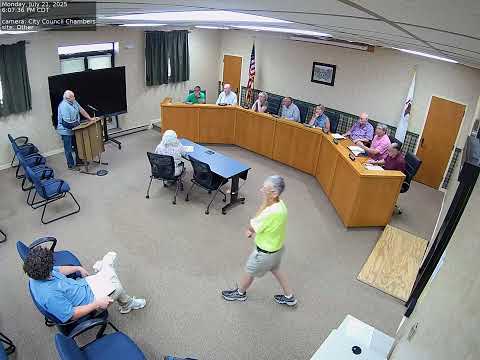
Residents report repeated sewage backups, council pledges follow-up on stormwater fixes
Summary
At a City Council meeting residents described repeated basement sewage backups and severe stormwater flooding near Washington School; council members said staff will inspect catch basins, explore retention options and continue coordinating grant funding and repairs.
At a City Council meeting, residents reported repeated basement sewage backups and heavy storm runoff in the neighborhood around Washington School and asked the council to take action.
The complaints, lodged during the public-comment period by Vernon Sondraff and Scott Linder, described both sanitary-sewer backups and stormwater pooling after intense rain. "I've had water in my basement 3 times in the 4 years. 3 times in the last 10 days," resident Vernon Sondraff said, describing sewage and stormwater entering his home. "There's got to be a big problem of people pumping water into this sanitary sewer. Okay. It needs to be addressed."
Council members and staff said they have begun looking at local drainage and sanitary connections and will continue work to identify short- and longer-term fixes. "We looked at catch basins because we want to make sure that they are basically open and not collapsed," a councilmember said. Staff member Teresa confirmed she is working on the issue and that the municipality is exploring whether the Washington School playground area could be used as a discreet retention area with the school's cooperation.
Why it matters: repeated sanitary backups pose health and property risks, and residents reported damage to personal property and repeated cleanups. Scott Linder described past events in which basements were inundated, saying he has seen "9 to 10 inches of sewage in my basement" during prior storms and that a neighbor had "2 feet of water in the basement." Council members said such events require both short-term relief (catch-basin checks, targeted repairs) and longer-term stormwater management.
What was discussed and next steps: residents suggested small local interventions — installing additional drains at curbside, raising sidewalks near the school to act as a temporary dam and creating retention to slow runoff — and noted unknown discharge points from yard pipes and sump pumps. Sondraff said he is having a backflow/check valve installed "on the thirtieth" and estimated the installation will cost about $4. Council members warned that pumping sump-pump discharge into the sanitary system is not permitted. Staff said they will trace problem lines where possible, inspect catch basins and consult with an engineering contact (referred to in the meeting as Kamlin) about whether the school playground could be adapted to provide retention during heavy storms.
Council context and constraints: council members noted past investments — bypass lines and new pumps in other neighborhoods — that have reduced similar problems elsewhere but said aging underground lines and unusually heavy rains can still overwhelm the system. The city manager reported that staff recently submitted a $50,000 capital grant application intended to help address stormwater issues on Turk Street; the grant will not cover full project costs but could fund part of a solution.
At the close of the meeting, council members encouraged colleagues to inspect problem locations during storms so staff and elected officials can better see where water flows. Council members also invited Sondraff to show photographs and video of the flooding to members after the meeting.