Get Full Government Meeting Transcripts, Videos, & Alerts Forever!
Get email alerts on the Comprehensive Plan Housing topic
No spam. Unsubscribe anytime.
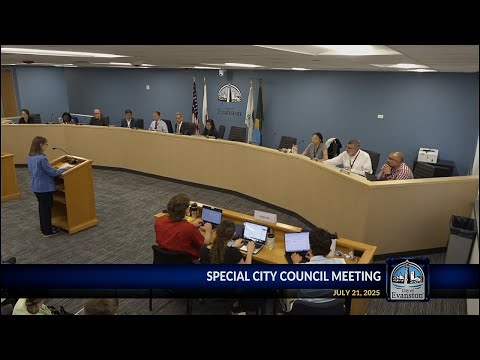
Hundreds of residents press Evanston council on affordable housing, zoning and displacement during Envision Evanston hearings
Summary
At a July 21 special meeting, more than 40 public commenters urged the City Council to address housing affordability, questioned blanket upzoning, and called for explicit anti-displacement and equity measures in the draft Envision Evanston 2045 comprehensive plan.
Dozens of Evanston residents pressed the City Council on July 21 to make housing affordability and anti-displacement an explicit priority in the draft Envision Evanston 2045 comprehensive plan.
Speakers representing neighborhood groups, advocacy organizations and residents delivered a steady stream of concerns that the plan’s language—especially phrases invoking “housing diversity” or citywide “increase housing supply and housing choices at all income levels”—could be interpreted as blanket upzoning that benefits developers but does not guarantee housing affordable to low- and moderate-income Evanstonians. Paul Breslin, identifying himself from the Evanston Action Coalition, warned that “affordability for everyone who wants to live in Evanston is unachievable with existing resources” and urged the council to consider evidence-based alternatives.
Many commenters challenged the assumption that market-rate development will “trickle down” into affordability. Linda Damashek said Evanston already has a “diverse housing stock” and that middle housing could be achieved without citywide upzoning. Multiple speakers cited studies and local examples they said show new luxury units have not produced lower costs for lower-income renters and homeowners; Meg Welch said there is “no consensus among housing experts” that blanket upzoning alone yields affordability.
Advocates for low-income and unhoused residents urged the council to pair zoning changes with funding and anti-displacement policies. Rodney Dawkins, speaking as a member of Connections for the Homeless’ Participant Advisory Board, said he wanted to remain in Evanston but could not afford it, and called for “more housing at more price points and in more forms.” Sheremer Chivanas, associate director at Connections for the Homeless, told the council the organization served “about 3,500 Evanstonians” last year and asked the city to include more clarity on subsidies, supportive housing and services in the plan.
Other themes in public comment included support for “missing middle” housing such as duplexes, fourplexes and cottage courts; concern about the removal of T1/T2 transition buffers near Northwestern University; and calls for clearer, enforceable commitments to deeply affordable units and rent protections. Philippe Largent of AARP Illinois urged policies that allow “duplexes, fourplexes, cottage courts” to increase housing options for older adults. Johns Hopkins-style data and local speakers were cited to support competing claims about whether upzoning would help or harm affordability.
Why it matters: Commenters said the comprehensive plan will guide future zoning and development decisions, so language in the plan matters. Several speakers warned that deferring decisions to later rezoning steps would leave neighborhoods exposed to development patterns they oppose. Others said the plan must explicitly pair zoning changes with funding, anti-displacement measures and partnerships (including with institutions) to produce units affordable to teachers, nurses, seniors and long-time residents.
Ending: The council did not adopt the final comprehensive plan at the July 21 meeting. The meeting record shows the council will continue discussion at a special session on July 30; public commenters said they will return until the plan includes clearer, enforceable commitments to affordability and anti-displacement measures.