Get Full Government Meeting Transcripts, Videos, & Alerts Forever!
Get email alerts on the Municipal Finance Utilities topic
No spam. Unsubscribe anytime.
Palm Coast staff present utility and proprietary-fund budgets; council asks for clarity on reserves and fee policy
Summary
City staff presented stormwater, water/wastewater, building-permits, sanitation and IT enterprise budgets. Councilors sought clearer line-item breakdowns and asked staff to develop policy triggers for changing discounted permit fees and for reserve targets.
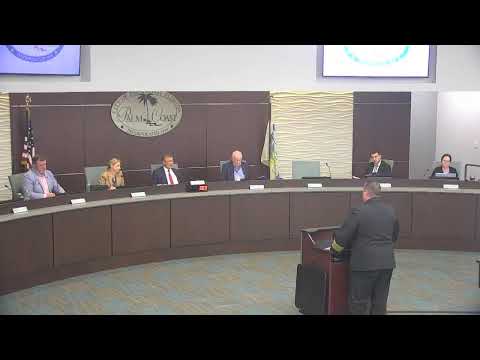
City staff presented the proposed FY2026 operating budgets for the city’s proprietary funds at the July 22 Palm Coast workshop, including stormwater, water and wastewater utilities, building-permit operations, sanitation collections and the IT enterprise fund. Highlights and requests: Stormwater Director Carl Cody outlined changes after a midyear reorganization that moved several positions and funded a new concrete/asphalt crew; stormwater operations showed a net budget decrease after one-time loans and ARPA funds are removed, while maintenance staffing increased. Cody said the city will continue a mix of in-house crews and contracted swale regrading to address a backlog of work orders. Utilities Director staff described the water/wastewater budgets and a recent rate study: charges for services were adjusted to support capital investment in treatment and collection systems. Staff noted a planned 2025 utility revenue bond issuance and higher interfund transfers to fund replacement and rehabilitation (R&R) projects. The utility presentation included staffing moves (two customer-service positions moved to administration; one finance position moved to wastewater plant operations) and operational changes tied to plant pilots and higher flows. Building-permit fund: Staff said declining permit revenue and the pending end of a 10% permit-fee discount require a rate/fee study; the building fund carried approximately $1.8 million in reserves (about six months of operating expense), below a prior 1-year target. Council asked staff to propose a policy mechanism so fee changes or discounts can be adjusted without repeated emergency decisions. Sanitation and IT: The sanitation contract includes a CPI-based adjustment (capped at 4% annually in the current contract), leading to an estimated per-household collection rate rise from $33.30 to $34.37 per month. The IT enterprise fund — supported by cell-tower leases and dark-fiber revenue — expects lower revenue next year because two fiber contracts expire; the budget includes capital outlay for network inventory, gap repair and strategic planning. Why it matters: Several council members emphasized the need for clear presentation of net changes after staffing transfers, the legal limits for enterprise-fund reserves and an administrable reserve/discount policy so the building-permit fund does not oscillate between surpluses and discounts. Next steps: Council gave staff directional consensus to eliminate the 10% permit-fee discount and to bring a fee-study and a proposed reserve/discount trigger policy for council adoption; staff will provide a clearer “backed-out” view showing the effect of personnel transfers on year-over-year percentage changes.