Get Full Government Meeting Transcripts, Videos, & Alerts Forever!
Get email alerts on the Capital Improvement Plan topic
No spam. Unsubscribe anytime.
Commissioners tentatively approve CIP while debate centers on urgent public works facility
Summary
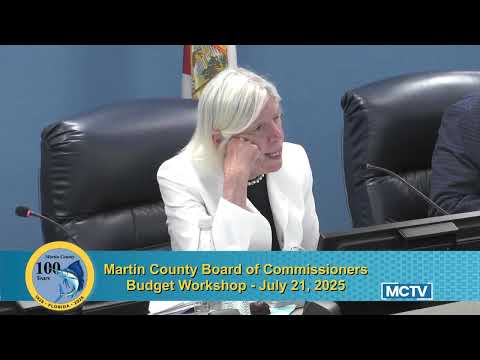
The board tentatively approved the county's capital improvement plan, but commissioners spent much of the workshop debating where to fund an urgently needed consolidated public works facility after county leaders said the airport property must be vacated within years.
Martin County commissioners tentatively approved the fiscal 2026 Capital Improvement Plan on a 4-1 vote but spent the bulk of the workshop debating how to pay for a long‑deferred public works facility the county now says it must relocate. The board briefly revisited the CIP that staff presented in April and added ad valorem funding, but commissioners pressed for faster action on the public works move after officials said the county faces eviction from its airport site.
The discussion matters because county staff estimate the public works facility could cost an estimated $80 million to $100 million, and officials said rising uncertainty about ad valorem collections makes timing urgent. “We desperately need to build this facility,” Commissioner Hurd said during the workshop as she pressed colleagues to identify budget adjustments or saleable property proceeds to accelerate construction.
Why it matters: county leaders said the existing public works compound at the airport is obsolete and overcrowded, and the county will lose its current license for the airport property unless it comes into compliance with federal aeronautical‑use requirements. George Stokes, assistant county administrator, told the board the FAA process could stretch for years but advised the county to assume roughly five years before compliance actions become unavoidable.
What commissioners discussed and staff proposals: staff and commissioners weighed three options: (1) build on the parcel purchased in 2018 off Canner Highway (which commissioners said is inconvenient and includes associated road and access costs); (2) consolidate onto part of the fairgrounds and adjacent parks property (speakers cited differing acreage estimates in the discussion and asked staff to confirm exact site size); or (3) finance construction using a public‑private partnership (P3) or traditional borrowing. Sean Donahue, General Services director, and county consultants explained a P3 would roll design, construction and financing together and could reduce upfront cash need.
Financing detail discussed on the record: staff and consultants said a P3 or lease‑purchase approach could reduce the county's upfront requirement to something in the range of $0 to $20 million, with the remainder financed through lease/repayment terms; that range depends on the project scope and how much county equity is contributed. Commissioners also discussed selling the Canner parcel to help fund a new site and noted the county could save about $300,000 a year in current airport operational license costs by moving off the airport property.
Constraints and caveats: commissioners and staff repeatedly cautioned that the Canner parcel purchased in 2018 is in a remote location and may not be suitable for a long‑term, 25‑to‑30‑year facility, and that building on the fairgrounds would require decisions about whether to retain or sell portions of that county asset. Staff said a clinic co‑located with the facility could be funded from the county's health system allocation rather than general revenue.
Next steps and board action: the board voted to tentatively approve the CIP but directed staff to return before the final budget hearing with concrete options: a list of projects that could be deferred, updated revenue assumptions, a P3 feasibility update and updated site testing (including acreage and stormwater/turn‑lane needs) for the fairgrounds site. Commissioners asked staff to bring those options before the final budget hearing so the board can decide whether to reallocate existing CIP funds toward the public works facility.
Ending: The board's tentative approval keeps the CIP on track for the August/September truth‑in‑millage and budget hearings, while staff work to produce the financing scenarios and site feasibility details commissioners requested.