Get Full Government Meeting Transcripts, Videos, & Alerts Forever!
Get email alerts on the Public Safety Lpr topic
No spam. Unsubscribe anytime.
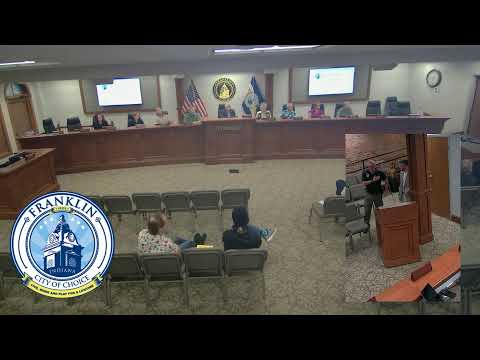
Franklin City Council receives briefing on Flock Safety license-plate readers; no action requested
Summary
City officials and a Flock Safety representative described how the city uses license-plate reader cameras for investigations, explained data access and retention rules, and said the contract decision rests with the Board of Works; council asked technical and privacy questions but took no vote.
Franklin City Council members on July 21, 2025, heard a 45-minute informational briefing on the city’s Flock Safety license-plate reader (LPR) system from City Attorney Lynn Gray, Police Chief Kirby Cochran and a Flock Safety representative, who said the technology aids investigations but that the council was not being asked to take any action.
The briefing followed a public-records request and constituent questions about whether a contract extension required council approval and about privacy protections. "This is something that we're not asking you to take any action on tonight, but this is for informational purposes only," City Attorney Lynn Gray told the council, explaining the presentation was intended to provide elected officials background to respond to constituent inquiries.
The nut of the presentation was that Franklin’s police use fixed LPR cameras to capture still images of license plates on public roads and then compare those images, in real time or during investigations, to databases such as Amber Alert and the National Crime Information Center (NCIC). "This Flock Safety is the best tool that's come along in my 30 years," Lieutenant Chris Tennell said, describing several local cases where LPR data helped identify vehicles and suspects.
Cameron Simmons, who identified himself as representing Flock Safety's government-affairs practice, said Flock operates in "over 6,000 communities across the United States" and described built-in privacy features. He said Flock stores images in the cloud for a limited period ("usually for 30 days on a rolling basis") and purges images that are not tied to active investigations. Simmons also described an audit trail that records search reasons or case numbers when officers query the system.
Chief Cochran and Tennell told council members that Franklin currently deploys 13 fixed LPR cameras plus one mobile "Flex" unit that can be repositioned. Cochran said the department also has access to other agencies' LPR networks and private-sector cameras when those owners choose to share images with law enforcement. "As soon as I enter a plate, it's checking theirs also," Cochran said, adding that private customers may choose to share cameras with police but that private entities cannot access the department's law-enforcement data.
Council members asked technical and policy questions: how many lanes a camera can cover (often two, sometimes four), whether Flock can search by vehicle make/model or partial plate (yes, via vehicle "fingerprints"), and whether an LPR hit alone justifies a traffic stop (officers must verify details; a match prompts further investigation). Simmons and Cochran also discussed cybersecurity protections (storage encrypted in transit and at rest, use of Amazon Web Services, SOC 2/ISO-related safeguards) and said Flock and departments follow standard operating procedures to reduce misreads.
No formal council action, ordinance, or vote was requested or taken on the LPR contract during the meeting. Gray said the city’s contract decisions for the system are handled by the Board of Works rather than by council vote. The presenters encouraged local transparency measures; Simmons described a free public "Transparency Portal" Flock offers to display camera counts, sharing partners and an LPR use policy if the city elects to publish that information.
Council members and staff discussed next steps: the police department is drafting or updating an LPR policy and already reviews access logs internally; Gray reiterated that council members should use the information if constituents ask questions. The presentation closed with officials saying the system has been repeatedly useful for recovering stolen vehicles, locating missing persons and assisting investigations, and with the council taking no immediate action.
Ending: City officials said they would continue work on department policy and transparency options and that council members could share the information with constituents. No ordinance, contract amendment or formal vote on the Flock system occurred during the July 21 meeting.