
West Linn staff lays out roughly $6.4 million in unmet general‑fund needs and a potential levy option
Get AI-powered insights, summaries, and transcripts
Subscribe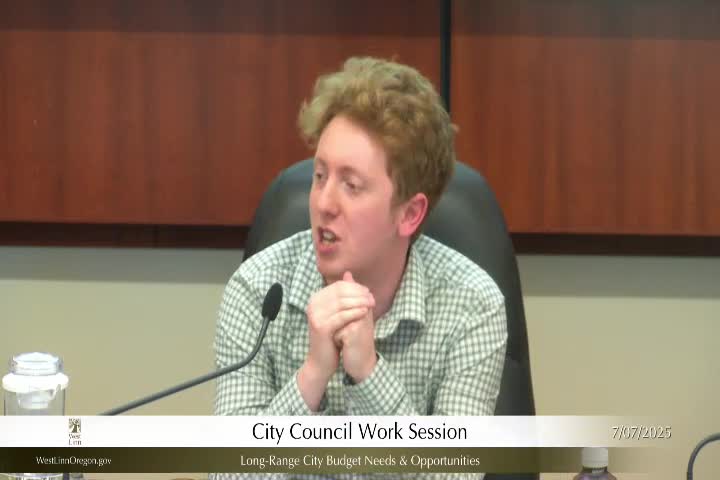
Summary
At a July 7 West Linn City Council work session, staff presented a staffing list and unfunded projects in the general fund — roughly $3 million in personnel and about $3.5 million in facilities projects — and outlined a five‑year local option levy that staff estimates could raise about $2.3 million a year.
At a July 7 work session, West Linn city staff told the City Council the municipal general fund faces ongoing pressure and presented a package of unmet staffing needs and capital projects that together total roughly $6.4 million, and outlined a potential five‑year local option property tax levy as one way to stabilize services.
City Manager (Mr. Williams) opened the discussion by saying the staffing list is "just under $3,000,000 a year" and that the project list is "about roughly 3,000,003 and a half million dollars," figures staff called a starting point for council and community prioritization.
Why it matters: staff told the council that, while the adopted biennial budget is balanced, a longer‑term forecast shows a shortfall that could force service reductions unless the general fund is stabilized. Staff recommended first addressing a stabilization gap (they cited about $1.25 million a year as a conversation starter) before committing to new permanent services.
Staff details and numbers
- Staffing: The administration presented a general‑fund staffing list that the packet and staff repeatedly summarized as "just under $3,000,000 a year." Major categories highlighted were public safety (police), parks and recreation, library outreach, planning/counter support and communications capacity. City staff said most of the requests are recurring personnel costs rather than one‑time purchases.
- Police: Chief Peter Mahuna listed five categories of police positions under consideration. He said the department currently has 29 sworn officers for an approximate city population of 27,500 and called the agency "the smallest agency per capita in the metro area." He stressed response‑time impacts: Chief Mahuna said the average response time for priority 1 and 2 calls rose from 6 minutes, 32 seconds in 2020 to 8 minutes, 48 seconds last year. He also quantified some workloads: "One person wrote 285 reports last year" describing the workload of the community service officer position, and he said the traffic officer "wrote 916 citations and warnings in 2024," compared with roughly 740 warnings and citations written by the rest of the department that year.
- Parks and facilities: Parks and Recreation Director Megan Bigjohn described both personnel and capital needs. On staffing she listed roles including an additional building maintenance worker, a natural‑areas manager (fuels reduction, trails and habitat work), a full‑time recreation coordinator to support the Adult Community Center and broader programming, and a park ranger to provide weekend/evening presence. On capital projects she pointed to deferred‑maintenance items: playground replacements, accessibility improvements, an adult community center generator, a facilities master plan and elements from the parks master plan such as a non‑motorized boat launch and potential improvements at Parker Road. Bigjohn also identified the bookmobile (or a multiuse outreach vehicle that could double as a mobile EOC) as a possible project tied to library outreach.
- Other general fund requests: Staff proposed an additional communications position to support outreach and advisory‑group work; an entry‑level planner to speed counter services and long‑range work; and a library outreach librarian. Staff noted some duties often performed now by existing staff would become formalized responsibilities if those positions were added.
Revenue options and tradeoffs
Staff discussed the structural limits on the city’s permanent property tax rate, telling the council that Oregon governments operate with a "frozen" base rate set in the 1990s and that the usual mechanism to raise ongoing general‑fund property tax revenue is a voter‑approved five‑year local option levy. Staff said a five‑year local option levy at 50 cents per $1,000 of assessed value would generate roughly $2.3 million a year in West Linn; staff presented that figure to give council a sense of scale for community conversation.
Councilors and staff emphasized options for phasing and blending funding: staff characterized some projects as one‑time capital items while most staffing requests are ongoing, and suggested council could pair stabilization, a set of high‑priority positions and a project list in different combinations.
Council reaction and next steps
Council members asked for more detail and community engagement. Several councilors suggested polling or shorter rotating online surveys to gather resident priorities and willingness to pay; others proposed convening an advisory group to vet priorities before any ballot referral. City Manager (Mr. Williams) said staff will return with options and suggested an August or early September follow‑up work session focused on polling options, communication plans and more refined cost estimates.
No final decisions were made at the July 7 session; staff framed the material as a conversation starter and requested any additional items or priorities from councilors to include in the next round of analysis.
Votes at this meeting
The only formal recorded vote during the work session was approval of the meeting agenda. A motion to approve the agenda was moved and seconded (movers not specified in the audio); roll call recorded five "yes" votes: Councilor Bonnington; Councilor Breit; Councilor Baumgartner; Councilor Kroner; and Mayor Biel Stoskie. The motion passed.