Get Full Government Meeting Transcripts, Videos, & Alerts Forever!
Get email alerts on the Community Development Code topic
No spam. Unsubscribe anytime.
West Linn staff advance CDC 'cleanup' changes but pull limited land‑use decision proposal for attorney review
Summary
Planning staff presented Community Development Code clarifications on density calculations, partition exemptions and lot shape standards and said they would remove a proposed change to limited land‑use decision authority for further review after public comment raised concerns about removing the Planning Commission from class 2 design review.
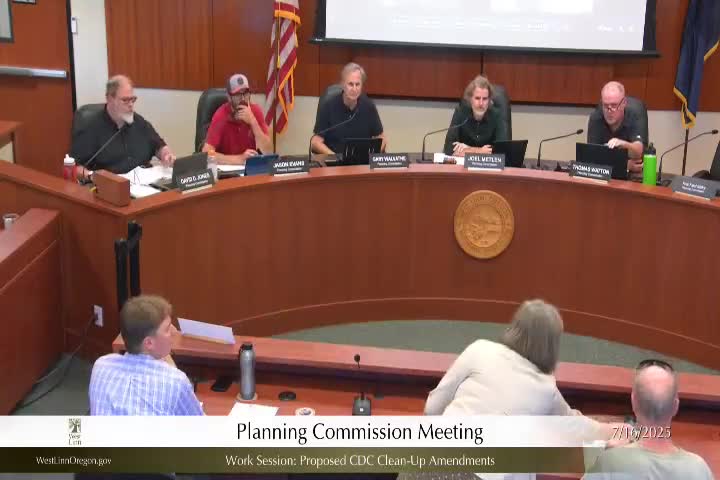
At its July 16 meeting, the West Linn Planning Commission heard a staff presentation on a package of Community Development Code (CDC) “cleanup” amendments and was told staff will move forward with three technical amendments while pulling a fourth, more substantive change for legal review.
The three topics staff proposed to carry forward are (1) clarified minimum/maximum density calculations and standardized definitions for “developable gross area” and “developable net area,” (2) a clarification to the partition minimum‑density exemption so a small land division cannot be used to evade minimum density requirements, and (3) new, objective standards to encourage rectilinear (square or rectangular) newly created lots. Planning staff said they will remove topic 4 — a proposed change to limited land‑use decisionmaking that would have shifted some Class 2 design reviews and subdivision decisions away from public hearings before the Planning Commission — and return that item after consultation with the city attorney.
Darren Weiss, planning staff, told the commission: “we're proposing to pull out topic 4 from the code amendment package, and just move forward with the first 3 topics, and then circle back to the planning commission with topic 4 after I can get together with the city attorney's office.” The Planning Commission scheduled a public hearing on topics 1–3 for August 6, 2025; topic 4 will be returned to the commission at a later date for discussion.
What staff would change
• Density calculations — Staff said there is no single, clear location in the CDC that shows how to calculate maximum and minimum density. The proposed edits create a single measurement section (CDC 5025) that defines developable gross and net area, excludes Type 1 and 2 lands, park land, rights‑of‑way and private streets from the net area, and preserves an existing option allowing applicants to subtract heritage or significant trees when calculating developable net area. The city’s existing 70% minimum density requirement would still apply once the net developable area is calculated.
• Partition minimum‑density exemption — Staff proposed clarifying language so that the statutory allowance to reduce zone capacity for a single parcel with negligible effect cannot be used to avoid minimum density by repeatedly claiming a three‑lot partition exemption. Weiss demonstrated with a numeric example that a 5‑acre site’s maximum and 70% minimum density can be calculated and that the current ambiguous language could be read to allow an applicant to avoid minimum density by limiting an application to three lots; the amendment would close that interpretive gap.
• Shape of new lots (rectilinear standard) — Staff proposed objective, illustrated standards to discourage irregular lot lines that create unusable land and to promote future street extension and predictable neighborhood form. The draft exempts unusual situations where rectilinear layout is “not practicable” because of a street radius, natural features (for example creek drainages), or existing lot lines.
Public testimony
Three members of the public addressed the commission during the CDC discussion and urged caution or action on the pulled item 4. Russ Axelrod, identified himself as a former mayor and former planning commissioner and said the package is being presented as required to comply with “Senate Bill 15 37 passed by the legislature in 2024” and warned that the limited‑decision proposal would “remove the Planning Commission from all class 2 design review and permitting applications, essentially eliminating the core and essential function of our planning commission.”
Terrence Shoemaker, a West Linn resident, told the commission the proposed change would give “approval/denial authority to one person, the planning director,” and called that “an unnecessary and drastic change” that could erode public trust and invite legal challenges. Nicole Jackson, another resident, echoed those comments and urged the commission to “pursue [an] exemption process under SB 15 37” or otherwise ensure public hearings remain available.
Staff and commissioner discussion
Commissioners asked staff to avoid discussing specifics of private property that might later come before the commission. Weiss said the city had received new guidance from the state Department of Land Conservation and Development (DLCD) and therefore wanted to discuss the limited‑decision topic with the city attorney before returning it to the commission. Commissioners clarified technical points — for example that “acres gross” and “acres net” will be replaced consistently with the developable gross/net terminology, and that heritage or significant trees may still be subtracted in the net area calculation if the applicant elects that option.
Formal actions and next steps
No ordinance or code amendment was adopted at the July 16 meeting. Staff announced a public hearing for topics 1–3 on August 6, 2025. Topic 4 (limited land‑use decisionmaking) was removed from the current package and will be returned to the commission after the city attorney reviews the new state guidance. Staff also listed the chapters that would be revised (definitions, Chapter 5 measurement rules, PUD chapter cross‑references, and design review/land division chapters).
Why it matters
Commissioners and residents framed the package as largely technical and clarifying, but public commenters and several commissioners flagged item 4 as substantive and potentially transformative for public participation and the Planning Commission’s role. The decision to remove topic 4 for attorney review reflects those concerns and creates a discrete next step — legal analysis — before the commission takes any action on a proposal that would shift decision authority.
Ending
Staff asked commissioners to submit any further questions in writing before the August public hearing so staff could circulate answers in advance. The commission reserved further discussion of topic 4 until after the city attorney’s guidance is received.