
Tualatin Valley Fire and Rescue outlines wildfire deployments, EMS programs and levy effects in West Linn update
Get AI-powered insights, summaries, and transcripts
Subscribe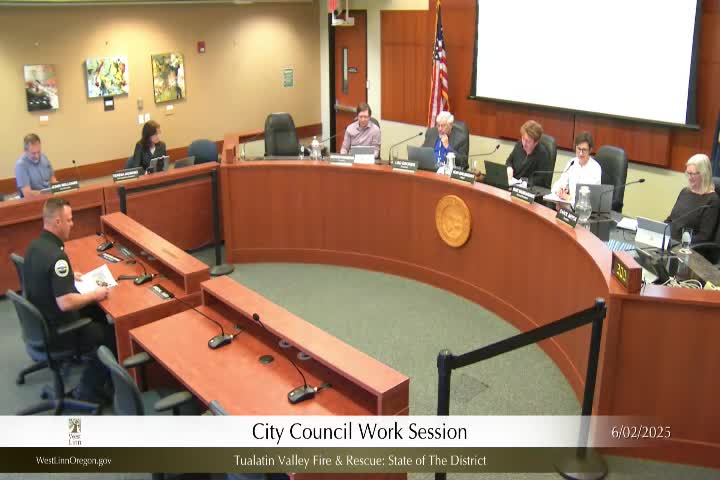
Summary
Deputy Chief Patrick Fale told the West Linn City Council that 2024 and early 2025 saw record wildfire deployments and that TVF&R is expanding non-transport EMS programs, relying on a May 2024 local option levy and a 2021 bond to fund staff and capital projects.
Deputy Chief Patrick Fale of Tualatin Valley Fire and Rescue told the West Linn City Council on June 2 that 2024 was an unprecedented wildfire year for Oregon and that the district is expanding EMS programs and infrastructure to manage rising call volumes.
Fale said TVF&R tracked “record setting 1,900,000 acres burned” in 2024 and that the Oregon State Fire Marshal’s office deployed 88 task forces. He told council members that the district also sent crews to California in 2025, including “14 firefighters down to Southern California, for a block of time and 1 battalion chief to oversee the 370, Oregon firefighters that were deployed.”
The presentation summarized local response data and new programs aimed at reducing avoidable 911 usage. Fale described an incident dashboard for West Linn, noting about 1,800 incidents inside city limits in the tracking dashboard and that TVF&R handles roughly 60,000 incidents per year across its service area. “We can’t deploy our way out of this,” he said, describing efforts to reduce low-acuity transports.
To address frequent calls from skilled nursing and other high-need customers, TVF&R has introduced advanced-practice community paramedics and an Advanced Resource Medic (ARM) program. The ARM unit, funded by a two-year state grant, includes a nurse practitioner and a paramedic and primarily responds to skilled nursing facilities to deliver higher-level care at the site and reduce emergency department transports.
Fale also described a nurse-navigation program, run in partnership with Washington and Clackamas counties and AMR, that routes low-acuity 911 calls to registered nurses who can find alternatives to emergency transport when appropriate.
On financing, Fale reminded council members that voters approved a five-year local option levy in May 2024 to fund the hiring of 36 additional firefighters and paramedics over five years. “In May 2024, voters approved a 5 year levy that allows for hiring of 36 additional firefighters and paramedics over the next 5 years,” he said. He said the TVF&R total tax rate was $2.10 and would rise to $2.34 on July 1.
Fale reviewed recruitment and training initiatives — including partnerships with high schools, community colleges and a Portland Metro Fire Camp — and internal development programs for lieutenants, apparatus operators and captains. He said recruitment numbers have tightened but candidate quality remains strong.
On capital projects, Fale reviewed the district bond approved by voters in February 2021. He identified station rebuilds and upgrades in the bond package: a temporary station and rebuild at Station 35, a teardown and rebuild of Station 20 in downtown Newberg, adding a third station (Station 22) in Newberg, and a needed training-center rebuild. He noted rising construction costs, saying stations that cost $8–9 million five years ago now run $14–15 million.
Council members pressed Fale about frequent calls from skilled nursing facilities. Fale said staff turnover at facilities — which his team tracks — contributes to calls for low-acuity needs and that community risk reduction and the ARM unit can help but will not eliminate the problem. He said the ARM program would not likely move the needle by more than a small percentage of overall call volume. He suggested advocacy at the state level for staffing or regulatory changes in facilities and noted past local attempts elsewhere met strong opposition from industry lobbyists.
Council members offered support for legislative outreach. One council member said they would be willing to assist if TVF&R develops legislative concepts for Salem.
The presentation closed with an invitation to view a year-end review video and with TVF&R staff in the chamber; council members thanked the firefighters for the update and for service to the community.