
Commission approves ‘Project Wolf’ data center after weeks of debate over location, power and community effects
Get AI-powered insights, summaries, and transcripts
Subscribe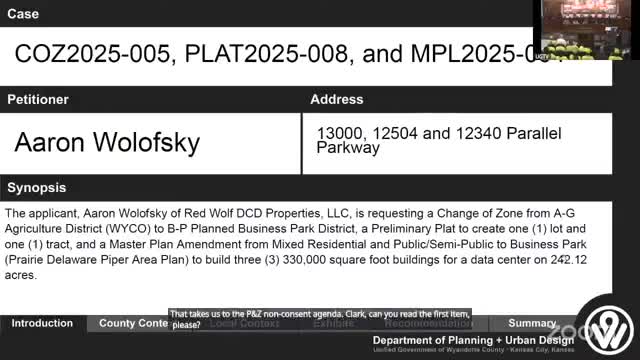
Summary
The Unified Government approved zoning and master-plan changes for a 550-acre data-center campus known as Project Wolf after debate over noise, power demands, and neighborhood impacts. Supporters said the project will bring jobs and millions in taxes; some nearby residents urged revisions and more community protections.
The Unified Government Commission voted this month to rezone about 550 acres north and south of Parallel Parkway for a proposed data-center campus known as Project Wolf, approving a series of master-plan amendments and change-of-zone requests amid debate over community impacts and electric infrastructure.
Supporters, including economic-development organizations and construction and trades unions, argued the campus would produce long-term tax revenue, construction and permanent jobs, and infrastructure upgrades. Opponents — mainly residents nearest the site and several commissioners — raised concerns about visibility, generator and cooling noise, stormwater, and electromagnetic fields, and urged additional safeguards and time for neighborhood negotiation.
Project Wolf, proposed by Red Wolf DCD Properties LLC, would be built in phases. The plan submitted to the commission shows six large buildings (three per phase) each with a BPU (Board of Public Utilities) substation nearby. Company counsel Kurt Peterson told commissioners the first building and the south substation could be under construction in 2026 and operational by 2027, with full build-out over several years.
Why it matters: Commissioners emphasized tax revenue and jobs. Staff and developers estimate each finished building could generate about $2.2 million a year in property tax revenue, and the campus could produce roughly $13 million annually in property tax when complete. Commissioners said the revenue could help reduce long-term pressure on the mill levy and fund services, while opponents said promised benefits do not eliminate local risks.
Key technical issues discussed: residents and staff asked about how the campus would look, how visible it would be from surrounding streets and yards, and whether background noise would exceed local limits. Developers provided engineered sight-lines and said landscaping, berms and naturally rising grades would screen the buildings; they also presented acoustical estimates showing generator noise at the nearest homes would decrease to a whisper-level (about 23 dB) after distance and landscaping attenuation. On power, BPU staff and the developer said the utility expects to be able to serve the project in phases and that the developer would fund required substation and distribution upgrades (estimates for a substation range roughly from $10 million to $18 million depending on design).
What commissioners decided: The commission approved the change of zone and related master-plan amendments in separate roll-call votes. The south phase (COZ2025-006) passed 8–2; the north phase (COZ2025-005) and its associated master-plan amendments passed by similar margins. During the hearings residents near A 130th Street and other corridors urged the commission to require additional neighborhood protections, insist on written community‑benefit commitments from the developer, and ensure stormwater and road improvements are completed before construction.
Developer commitments and next steps: Project representatives and staff said the developer plans to finalize a development agreement that will spell out infrastructure responsibilities (water, sewer, roads, electrical), mitigation (landscaping, berms, lighting and noise controls), and possible community benefits. Several commissioners asked staff and the developer to continue neighborhood conversations and return to the commission with any changes to the plat or development agreement. Staff warned that if the project did not return as a materially changed application it would likely be at least a year before an applicant could refile.
Ending note: The commission’s approval clears the way for site engineering, permits and coordination with BPU, but it does not end the process. Developers, BPU and the Unified Government will still need to finalize utility work, permitting and a development agreement. Neighbors said they will press for legally binding mitigation and clearer timing for road and stormwater work.