Get Full Government Meeting Transcripts, Videos, & Alerts Forever!
Get email alerts on the Economic Development Solar Storage topic
No spam. Unsubscribe anytime.
Commissioners discuss early-stage solar, storage and tax-abatement talks with developers
Summary
Young County officials and residents discussed a proposed large solar/battery project, recent Texas laws on battery safety and removal, and how any tax-abatement or pilot agreement would be structured; no formal agreement or vote was taken.
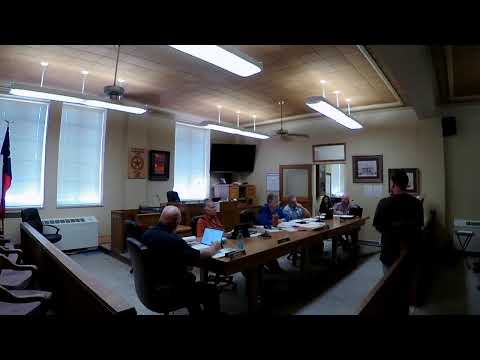
Young County commissioners and residents spent extended time discussing a proposed large-scale solar and battery-storage project, the county’s negotiating position on tax abatements and pilot agreements, and recent Texas legislation affecting battery facilities. The court did not take formal action on a deal during the meeting.
The discussion centered on what incentives the county might offer to attract the project while protecting county revenue. A county official (not otherwise identified in the transcript) said the county and its consultant have been “bouncing off ideas of pros and cons,” including possible donations to volunteer fire departments and road protection measures for both county roads and Texas Department of Transportation facilities. The official said the county had given developers copies of two recently enacted state laws they identified as relevant: “House Bill 3824,” on fire-safety standards and emergency operating plans for battery-storage facilities, and “House Bill 3809,” relating to removal of battery-storage facilities.
Why it matters: Commissioners and residents framed the talks as an early-stage negotiation with revenue and public-safety implications. Commissioners asked how a pilot or tax-abatement would be calculated, whether by asset value or by energy capacity. The county official said the current approach under discussion is to base taxation on megawatts, explaining, in the meeting record, “it’s on a megawatt basis,” and noting that while people think of value as an asset, the state assessment approach ties to energy-producing capability.
During the public-comments portion, residents raised several concerns: potential loss of land (one resident said the project could “clear cut 2,200 acres”), limited local job creation relative to land use, the effect of abatements on property-tax rates for other taxpayers, and the need for environmental and archaeological studies before construction starts. A speaker who identified himself as a resident asked whether an environmental study had begun; the county official said they had seen a developer checklist but had received no comprehensive update yet.
Speakers also discussed project valuation and tax calculations. One participant (referred to in the transcript as Mr. Snowden) had indicated that market values assigned per megawatt might be higher than the developers’ valuations, but no documentation was presented at the meeting. Commissioners and residents noted the county’s experience with previous large-scale projects (wind farms) and concerns about appraisal impacts.
No formal motions or votes were recorded on the solar project during the meeting. Commissioners instructed staff to continue negotiations and information-gathering; several requests were made for more data, including: - updates on the environmental and archaeological study status; - clarification of valuation numbers used in the pilot program (what dollar value per megawatt will be applied); - outreach to other counties where the same developer holds projects to learn how those negotiations proceeded and what local terms were used.
The court’s discussion also referenced competitive economic-development dynamics: one commissioner noted that “80% of something is better than 100% of 0,” arguing a substantial partial tax agreement might be preferable to losing the project entirely. Residents and other speakers countered that abatements reduce revenue that funds county services and requested tighter limits and safeguards if any agreement is reached.
The court did not adopt a resolution, approve a contract, or vote on a tax-abatement incentive at the meeting. Staff will return with further details when available.