
Larimer County staff outline expansion of restorative-justice circles in community corrections
Get AI-powered insights, summaries, and transcripts
Subscribe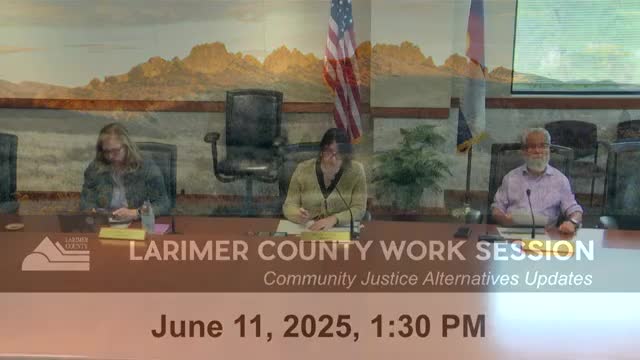
Summary
Larimer County Community Justice Alternatives staff on Wednesday, June 11, 2025, told the Board of County Commissioners they are expanding restorative-justice practices in Community Corrections and Alternative Sentencing to encourage accountability, repair harm and reduce recidivism.
Larimer County Community Justice Alternatives staff on Wednesday, June 11, 2025, told the Board of County Commissioners they are expanding restorative-justice practices in Community Corrections and Alternative Sentencing to encourage accountability, repair harm and reduce recidivism.
Emily Humphrey, director of Community Justice Alternatives, described the work as aligning with the agency’s mission to prioritize community safety while offering alternatives to punitive-only responses. “We are really focusing on the community to make them safer, holding our folks accountable but giving a different way, a different lens of looking at where they're at and why they're there,” Humphrey said.
The presentation outlined how staff are using restorative practices — everyday actions and structured circle processes — alongside formal restorative justice dialogues. Commissioners were shown the program’s recent training history, client examples and planned operational changes intended to give clients more opportunity to acknowledge harm, make amends and follow through on concrete action plans.
Staff described three principal applications: high-impact victim–offender dialogue (used only when parties agree and supports are in place), sharing/healing circles for clients or staff, and community-accountability circles aimed at reflective questions and reparative actions. Alex Danielson, Community Justice Supervisor, framed the distinction this way: “Restorative justice responds to the harm while restorative practices work to prevent it.”
CJA staff described a multi-year rollout. A core team began training in 2023, received a three-day circle-keeping training that included Project Elevate staff and an Indigenous elder, and has run circles with management, staff teams and clients. Staff said the unit cleared logistical hurdles — including security reviews for how clients are placed into custody during Administrative Review (AR) — before changing AR procedures to emphasize conversation over confrontation.
Among procedural changes presented: a revised AR chair script and seating to reduce power dynamics, new case-manager forms that document mental-health context and harms caused, a simplified set of client-facing questions written at a fifth-grade reading level, provision for a nonvoting support person for clients, and clearer, earlier communication of outcomes to clients. Ashley Villanueva, a case manager on the restorative team, said the changes are intended to make AR “a place of conversation” and to help clients understand next steps promptly.
Staff pointed to early operational results and client examples. Humphrey reported CJA’s recent warrant-clearance work as background outreach and service-delivery context: CJA “cleared 108 warrants. About 65 individuals walked through that door to clear their warrants,” she said, adding 12 people were turned away for not meeting program criteria. Two staff and one client shared written testimonials; staff said one client wrote an apology letter to a peer after stealing a vape, read it aloud and reached reconciliation with that peer.
Presenters described measurable tracking plans rather than completed outcome studies. Alexis Angley, director of Community Corrections, and other staff said anecdotal operational benefits already observed include fewer clients fleeing prior to AR hearings when the process and next steps were explained. Managers said the program will begin collecting AR and circle-related statistics — for example, termination rates and frequency of specific write-ups — to gauge impact over time.
Staff also outlined short-term next steps: expand client and staff circle sessions to Alternative Sentencing units, implement written action plans tied to AR outcomes, add an achievement wall and a mural to make AR spaces less punitive, and train additional peer-support clients and staff (a mid-June training was mentioned). Project Elevate and other external trainers will continue to be used for advanced facilitator training.
Commissioners asked about victim supports, measurement and community handoffs. Amanda Cucero, a Community Justice case specialist, said high-impact victim–offender dialogue requires careful readiness screening and victim advocates are on the restorative team; “it would take a lot of work and we would want to make sure that everyone in the process is ready for that,” she said. On measurement, staff said they will extract statistics from AR records and write-up trends to document changes in terminations, write-ups and other process metrics over time.
The presentation included acknowledgments of external partners and trainers, including Project Elevate, the Colorado Restorative Justice Council and an Indigenous circle keeper identified in the presentation as Grandmother Strong Oak, whose teaching staff said centered the circle practice in Indigenous traditions. Staff also said they drew early learning from the City of Fort Collins and Jefferson County programs.
No formal votes were taken; commissioners heard the work-session presentation and asked for follow-up materials. Humphrey said staff will bring back a written report to the commissioners with identified gaps and opportunities from a recent sequential-intercept mapping workshop, and staff said the circle team will report again when new data is available.
Larimer County staff described the restorative-practices effort as an operational change intended to keep community safety and client accountability central while adding structured opportunities for repair and reintegration. “We are giving them that foundation so that they can build from it,” Angley said, describing the goal of reintegration into community supports and services.
Follow-up items identified during the meeting included distributing the sequential-intercept mapping report countywide, training additional peer-support clients and staff, and returning to the commissioners with written AR metrics and a progress update on action-plan implementation.