
Public health official outlines local implementation plans after state expands clean indoor air law
Get AI-powered insights, summaries, and transcripts
Subscribe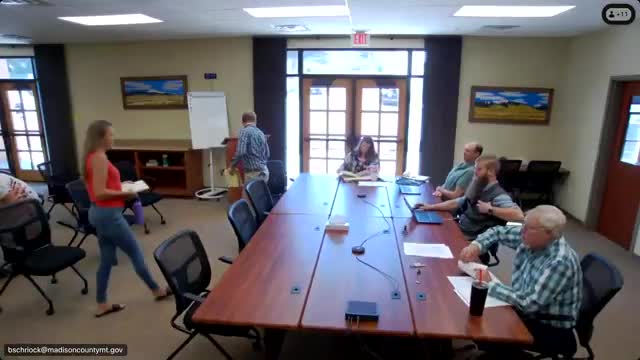
Summary
Erin Montgomery, Madison County public health tobacco prevention coordinator, reported on SB 390 implementation, local education plans for schools and a request to explore additional staffing/funding for prevention work across rural counties.
Erin Montgomery, Madison County tobacco prevention coordinator with Public Health, updated county commissioners on state and local developments in tobacco control and public education, including implementation steps after a state law expanded the Clean Indoor Air Act.
Montana’s recent legislation (referred to in the meeting as “SB 390”) broadened the Clean Indoor Air Act to include vaping and certain nicotine delivery products, Montgomery said. She told commissioners the bill passed and was signed into law on May 8, and that the state program must now implement new signage, training and deliverables. Montgomery said she sits on an implementation committee and that local signage and guidance will be distributed in coming months (she estimated signage circulation by September).
Montgomery described several local projects she is developing: a short, picture‑heavy training PowerPoint for all school staff showing what current vapes, pods and edible marijuana products look like and how students may hide them; a short survey to gather school‑level observations from teachers, custodial staff and cafeteria workers; and an outreach plan to support school nurses and local stakeholders. The school training aims to be concise (about 20 minutes) and to produce anonymized data to help prioritize local prevention interventions.
Montgomery also discussed funding and staffing. Tobacco program funding at the state level remains supported by the Master Settlement Agreement, she said, but public‑health staffing for prevention is limited by population‑based allocations. Madison and nearby frontier counties are grouped for funding allocations; Montgomery asked the commission to support the idea of pursuing an additional part‑time (.25 FTE) position or alternate funding to cover the geographic spread and travel time required for her work in this rural area. She noted long drive times between towns and the need for more local presence in schools and community events.
On enforcement and criminal‑justice links, Montgomery said she expects to consult with the county sheriff and county attorney as implementation proceeds and that some work will require interagency coordination.
Commissioners asked Montgomery to provide any proposals for staffing or funding so the commission could evaluate if county support or matching funds would make sense. Montgomery also raised a vehicle and reimbursement question for travel and transporting program materials; commissioners asked her to provide cost estimates and a proposal.
Montgomery concluded by noting ongoing coalition work with youth and plans to meet potential funders, including regional foundations, to support prevention activities and school adviser stipends if the county and partners pursue a school‑based youth coalition model.