Get Full Government Meeting Transcripts, Videos, & Alerts Forever!
Get email alerts on the Infrastructure Pavement topic
No spam. Unsubscribe anytime.
Council approves request for bids for 2025 MFT scarification and oil-and-chip work after debate on repair methods
Summary
The council approved solicitation of bids for the 2025 motor fuel tax (MFT) scarification and oil-and-chip contract and debated long-term trade-offs among scarification, mill-and-overlay and traditional oil-and-chip methods.
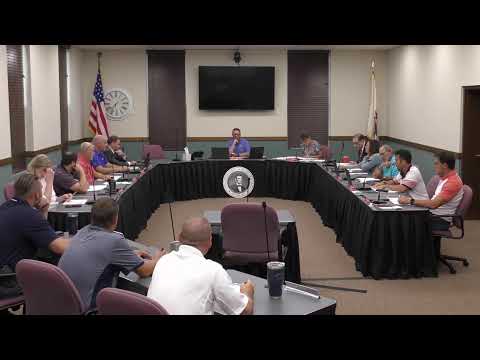
The Lincoln City Council voted to approve a request for bids for the 2025 Motor Fuel Tax scarification and oil-and-chip contract after extended discussion about road maintenance methods and costs.
Alderman Bateman urged the council to favor scarification — a process that grinds and regrades existing pavement — over traditional oil-and-chip work, saying residents prefer fewer repairs done to higher standards. “I'm hoping we can start working on that,” Bateman said, adding that scarified roads “would last longer” than surface treatments.
Public works staff, identified in the meeting as Walter Landers, explained cost comparisons for common methods. Landers said a mill-and-overlay (HMA) at 1.5-inch milling with a 2-inch overlay runs about $76 per linear foot; scarification (listed as “A2”) is about $36 per linear foot; a basic oil-and-chip (“A1”) is about $16 per linear foot. Landers also said the city has roughly 170 centerline miles of streets and noted that with the current annual budget — approximately $1 million in a prior year example discussed at the meeting — the city could repave roughly three miles.
Council members discussed the trade-off between repairing fewer streets to a higher standard and repairing more streets to a lower standard. Alderman Bateman said scarification was the most popular option in an online survey he conducted of residents, but other council members warned higher-quality treatments mean fewer streets receive work each year.
Alderman Sanders made the motion to approve the request for bids; Alderman Downs seconded. The motion passed on roll call. Council members directed staff to form a group to analyze road-repair approaches and report back to the council, but the motion approved only the request for bids, not a change in policy or budget allocation.