Get Full Government Meeting Transcripts, Videos, & Alerts Forever!
Get email alerts on the Abandoned Properties topic
No spam. Unsubscribe anytime.
Lafayette amends code to fast-track action on abandoned properties, sets fines and tax‑sale trigger
Summary
The Lafayette City Council approved Ordinance 20 25‑01, expanding the definition of vacant and abandoned structures, imposing maintenance duties on owners and establishing a tiered fine (starting $500 after 90 days, capped at $5,000/year). The change can also speed an abandoned‑property tax sale when taxes are unpaid.
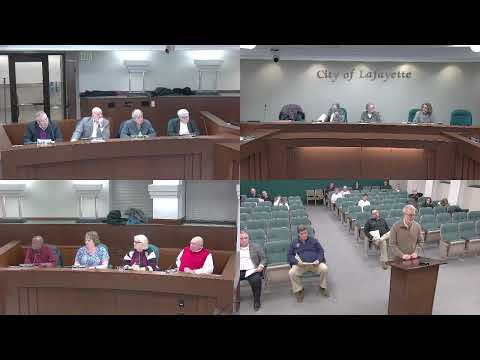
The Lafayette City Council approved Ordinance 20 25‑01 on first reading to amend Chapter 13.05 (Unsafe Buildings), broadening how the city identifies and responds to vacant and abandoned structures.
City staff said the amended ordinance adds specific indicators of abandonment — including boarded entrances, broken windows, terminated utilities, accumulated debris and similar signs — and imposes explicit maintenance responsibilities on owners, such as securing the property, maintaining landscaping, removing debris and ensuring structural soundness. City staff described a tiered enforcement path that includes notice and a 90‑day cure period; if owners do not act, fines may be imposed beginning at $500 and capped at $5,000 per year while noncompliance continues. Staff also said declaring a property abandoned may speed up the abandoned property tax‑sale process when property taxes are unpaid.
The change is intended to give code enforcement clearer criteria and tools to address long‑vacant structures that city staff say depress housing availability and property values and can foster crime. City staff pointed to a recent case in which issuing an order to show cause prompted a property owner to come to the city and begin repairs.
Council members asked technical questions about the ordinance’s mechanisms and limits. In response to whether the declaration would expedite city acquisition, staff said it can, by triggering an abandoned property tax sale and thereby shortening some parts of the tax‑sale process when taxes are delinquent. A council member pressed whether the fines are daily or annual; staff clarified the schedule is a one‑time $500 after the 90‑day cure period and then up to $5,000 per year while the property remains out of compliance, not a $500 daily fine.
A resident, Tyler Beach of 625 N. 12th Street, spoke during the public comment period about property maintenance and broader concerns; his remarks focused on examples of overgrown yards and offered a proposal about returning some tax‑acquired properties to residents under a reclassification program. The council did not act on that proposal during the meeting.
Councilmember Reynolds moved to hear and approve Ordinance 20 25‑01 on first reading; the measure passed on a roll call vote with all members present voting yes (8‑0).
The ordinance provides new enforcement tools for code officers and creates an administrative pathway intended to encourage owners to repair or transfer long‑vacant properties. City staff said the primary goal is to prompt owner action and to clear title impediments that delay reuse.