Get Full Government Meeting Transcripts, Videos, & Alerts Forever!
Get email alerts on the Transportation Recreation Ordinance topic
No spam. Unsubscribe anytime.
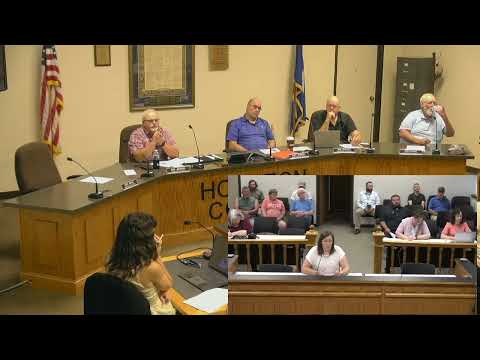
Houston County holds public hearing on proposed ATV, UTV and golf-cart ordinance; no action taken
Summary
The Houston County Board held a public hearing on a proposed ordinance to authorize and regulate ATVs, UTVs and street-ready golf carts on county roads. The sheriff and residents described how a county permit would work, raised enforcement and safety concerns, and asked for clearer education; the board took no final action.
Houston County commissioners held a public hearing on a proposed ordinance to allow and regulate all-terrain vehicles (ATVs), utility task vehicles (UTVs) and street‑ready golf carts on county roads, but took no action after hearing roughly a half-dozen residents and business owners. The sheriff described a planned county permit and education process and answered questions about enforcement, agricultural exemptions and reciprocity with adjacent jurisdictions.
The hearing matters because county statutes and local ordinances affect who can legally operate low‑speed off‑road vehicles on county roads, how law enforcement enforces those rules and whether local tourism and businesses gain customers or face new neighborhood conflicts. Commissioners said the hearing will inform a possible future ordinance; they did not adopt language at the meeting.
Sheriff Andrew spoke for the sheriff’s office and described the draft ordinance’s goals and a proposed permit process. “The ordinance that we proposed is to give actually the citizens more freedom than the current law,” he said, adding the office plans a streamlined permit people could apply for online with a temporary printout and a mailed sticker after review. The sheriff told commissioners the county could accept permits issued by other jurisdictions and that a county sticker could be honored in neighboring counties that have similar ordinances.
The sheriff explained a difference between agricultural registrations and recreational registrations under state rules: agricultural registrations limit use to agricultural purposes, while the recreational registration would be the category targeted by this ordinance. He also said age and training requirements cited in state statutes would apply: “Anybody under the age of 18 has to have a valid driver’s license and the ATV certificate,” he said during discussion about minors.
Public commenters expressed mixed views. Bev Bauer of the Caledonia area said residents already pay state registration: “We already paid $66 each for the Minnesota permit,” and asked whether counties would add more stickers and fees and how out‑of‑state riders would be handled. Gregory Hossman of La Crescent said concerns about traffic, pedestrians and enforcement should be considered where county roads run through denser neighborhoods. Colin Luz, a La Crescent business owner, urged the board to permit street‑ready golf carts, noting models sold in the county often include lights and turn signals and “actually top out at 25 miles per hour.”
Some La Crescent officials and residents said the city is still evaluating whether an ordinance would fit the city’s downtown redevelopment and pedestrian environment. Teresa O’Donnell Ebner, a La Crescent city councilor, said she was mainly concerned about minors as operators and wanted more education and age‑related limits implemented where appropriate.
Commissioners and the sheriff discussed enforcement expectations: the sheriff said deputies would not proactively stop every recreation vehicle but that the ordinance would provide clearer authority when enforcement was necessary, especially after crashes. Multiple speakers asked how county permits would interact with city permits and with out‑of‑state riders; the sheriff said city permits would be recognized as permits from another jurisdiction under the draft language and that the county planned a simple, possibly free or nominal, three‑year registration if the board chose to set one.
The hearing produced no ordinance vote. After public comment the board closed the hearing and returned to regular business. Commissioners said they will consider the public input and whether to return with a draft ordinance or fee schedule in a future meeting.