Get Full Government Meeting Transcripts, Videos, & Alerts Forever!
Get email alerts on the Police Statistics Survey Pilot topic
No spam. Unsubscribe anytime.
Montgomery County reviews 2024 police data, launches post‑911 survey pilot to measure service
Summary
Council staff and Montgomery County Police Department presented the 2024 Police Statistical Data Report and described an August pilot to send a multilingual text survey after certain 911/nonemergency calls; the report highlights officer attrition, rising overtime and internal‑affairs investigations, and gaps in representative survey responses.
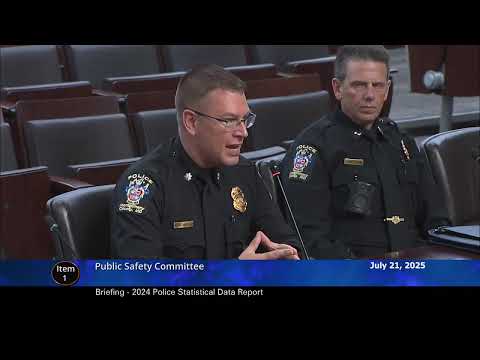
At a July 21 public safety work session, Montgomery County Council staff presented the county's 2024 Police Statistical Data Report and Montgomery County Police Department leaders described an August pilot that will send a short, multilingual survey by text to people after certain 911 or nonemergency calls.
The briefing matters because the report compiles disaggregated data the county is required to publish under local bills and state law, while the new survey pilot aims to provide regular, case‑linked community feedback about dispatch and officer performance.
Council staff told the committee that the department transmitted the calendar‑year 2024 report on Feb. 1 and released it to the council Feb. 25; the council held a public hearing March 18. Kristen Farag, the council staff member presenting the packet, said the report included most required datasets but noted the department had not completed an annual officer survey because that survey has not been funded in recent operating budgets. Farag summarized the department's November community survey (a Microsoft Forms release) as drawing 84 responses, 81 of them from county residents, with about 82% of respondents saying they either "highly trust or mostly trust" the Montgomery County Police Department to provide for their safety and about 79% saying they feel "very safe or mostly safe" in their neighborhoods. Farag said the November respondents skewed older (more than 60% age 56+) and were disproportionately white compared with county demographics, and she recommended targeted outreach or weighting to improve representativeness for future surveys.
Montgomery County Police officials described the planned pilot. Assistant Chief Nicholas Oggstein and Lieutenant Cody Fields said the Emergency Communications Center will send a roughly 15‑question text after the call is closed for a subset of call types; questions cover who the resident interacted with (dispatcher, officer or other staff), whether they were treated with respect and fairness, whether dispatch or officers processed the call in a reasonable time, and whether the person received needed help. Fields said the pilot will avoid sending surveys in cases that could re‑victimize callers (for example, certain sexual assault or child abuse calls), and that the vendor Axon will support text delivery and multilingual capability.
Council members raised representation and scope concerns. Councilmember Kristen asked how immigration or ICE concerns would be captured without conflating county police with federal enforcement; Oggstein said the survey will not include other federal agencies and is intended to capture the respondent's interaction with Montgomery County Police. Several councilmembers suggested a separate countywide survey or canvassing to reach residents who do not contact police and to capture broader public safety perceptions.
Staff and police officials noted limits to the pilot: only callers who generate an incident number in the communications center will receive the text, so contacts that are diverted entirely to other providers without creating an incident in the CAD will not be surveyed. The department said it will evaluate responses from the August–December pilot and adjust question content and distribution as needed.
The statistical report itself documented staffing and operational trends. Farag said the authorized sworn complement changed little from 1,281 officers in 2021 to 1,276 in 2024, but filled positions declined by about 128 officers over the period. The report shows a decline in officers assigned to neighborhood patrols (from 59% of field sworn in earlier years to about 50% in 2024) and a marked rise in patrol overtime; staff noted overall overtime rose by about 117% and said the approved FY25 overtime appropriation of $11.5 million is well below the department's internal projection at the time of the recommended budget (department staff said overtime spending was projected closer to $22.4 million and later estimated nearer to $25 million).
The report also showed complaint and investigative shifts under Maryland's Police Accountability Act of 2021. Farag said Internal Affairs investigations rose from 30 in 2022 to 58 in 2023 and to 110 in 2024; she attributed the increase to both state and local changes that now require certain community‑member complaints to be handled by IAD rather than at district levels. The department reported that total civilian complaints by district remained stable year‑to‑year, that use‑of‑force incidents rose modestly between 2023 and 2024 (reported in the packet), and that use‑of‑force‑related complaints that were sustained were rare in 2024.
The committee discussed whether the Feb. 1 statutory deadline to submit the police report creates timing conflicts with other annual reports; council staff suggested exploring a legislative change to shift reporting deadlines to reduce duplication and increase data accuracy. Police leaders also said they contracted for a staffing study of investigative services and were performing an internal patrol staffing analysis to be shared with the committee later this fall.
The session closed with the department and staff agreeing to run the pilot, return to the committee with pilot response metrics after December, and consider supplemental community outreach methods (canvassing, countywide surveys) to address representativeness.
For follow up, staff recommended the committee consider whether to seek a legislative change on the Feb. 1 deadline, what additional survey resources would be required to reach non‑callers, and whether to require additional datasets (for example, HHS‑partnered responses) by ordinance.