Get Full Government Meeting Transcripts, Videos, & Alerts Forever!
Get email alerts on the Board Of Equalization topic
No spam. Unsubscribe anytime.
Clerk outlines Board of Equalization appeals process, training gaps and recommendation to shift appointment timing
Summary
The Board of Equalization clerk described the appeals process for property owners, reported noncompliance rates for petitions, and recommended changing member expiration dates so new appointees can attend Department of Revenue training before hearings begin.
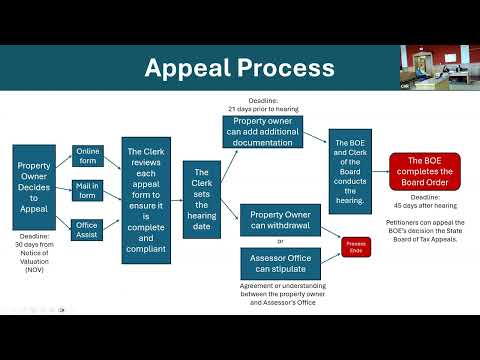
Purvi, clerk for the Board of Equalization, told the Board of County Commissioners on Monday that property owners must file appeals within 30 days of their notice of value and that many petitions are being deemed noncompliant because they lack required supporting statements. "The petitioner must file within 30 days of the date on the notice of value," Purvi said, and evidence must be submitted 21 days before a hearing. The clerk said noncompliant petition rates have fluctuated in recent years — about 18% in 2022, 3% in 2023 and 12% in 2024 — and the board’s target this year is fewer than 10% noncompliant petitions. That, she said, has prompted updates to the BOE website and the online form to include examples of common mistakes and a multistep guide for petitioners. Purvi described the hearing process and timelines to the commissioners: petitioners submit appeals electronically, by mail or in person; the clerk reviews filings for compliance; hearings are scheduled with roughly three months’ notice so petitioners can assemble records; board orders are issued within 45 days after hearings; and petitioners may appeal the BOE decision to the State Board of Tax Appeals. "Those have to be submitted 21 days prior to their hearing," she said of supporting documents. She also explained board composition and training: state law requires three BOE members appointed by the county commissioners; the clerk said two current members have completed Department of Revenue new-member training and a third member is scheduled to complete it next year. Purvi said newer members often lack historical knowledge and that some arrive after the DOR training has been offered, leaving them to perform duties without that instruction. To address that, she recommended changing BOE member expiration dates to April to allow appointments to occur early enough for new members to attend June training. Commissioners asked procedural questions and acknowledged the clerk’s work updating compliance materials. One commissioner praised the clerk’s recent efforts bringing the BOE into compliance and asked staff to pursue the proposed policy change on appointment timing. No formal board action was taken at the meeting; the recommendation to change appointment timing was presented for future action. The clerk also noted that when a petition is noncompliant she sends letters to petitioners offering an opportunity to correct the filing and that, when petitioners do not respond, petitions can be left as noncompliant. Purvi said the BOE operates separately from the assessor’s office and is responsible for ensuring properties are assessed at 100% of market value and that comparable properties are assessed comparably. She said the clerk’s office schedules hearings, maintains records and assists property owners through the process. Any further changes to BOE policy, including the expiration-date change, would be brought to the commissioners for formal action and ordinance or policy revision if needed.