Get Full Government Meeting Transcripts, Videos, & Alerts Forever!
Get email alerts on the Housing Production Plan topic
No spam. Unsubscribe anytime.
Southborough draft housing plan sets 5-year target of 255 new homes, outlines ADU, zoning and infrastructure strategies
Summary
A draft Housing Production Plan presented to the Town of Southborough’s Affordable Housing Trust recommends adding 255 dwelling units by 2030, including 28 subsidized units to meet a 10% SHI goal. The plan emphasizes ADUs, use of MBTA Communities overlay capacity, Route 9 redevelopment, wastewater planning, and tracking outcomes.
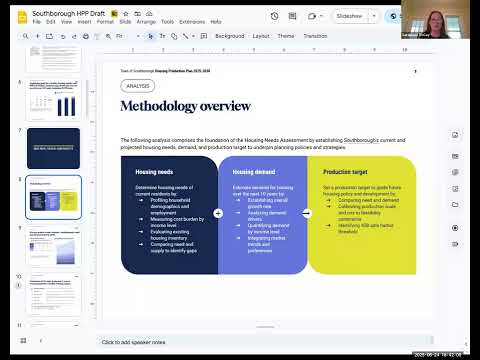
Sarah Brent, a consultant with Community Scale, presented a draft Housing Production Plan to the Town of Southborough Affordable Housing Trust, saying the plan “really has three main components,” including a housing needs assessment, community goals and strategies to reach them.
The draft concludes Southborough should add 255 dwelling units, including 28 subsidized housing inventory (SHI) units, between 2025 and 2030 to maintain a healthy housing market and preserve 40B Safe Harbor status. Brent summarized the analysis that led to the target: projected net household growth of 171 households plus additional units needed to maintain healthy vacancy rates and replace aging stock.
The plan breaks strategies into “production” actions that add homes and “nonproduction” steps to strengthen the local housing ecosystem. Brent identified five priority production strategies discussed by the committee: encouraging accessory dwelling units (ADUs) under recent state legalization, using capacity in the MBTA Communities overlay, removing an age-restricted unit cap in the town bylaw, identifying underutilized parcels along Route 9 for selective redevelopment, and coordinating wastewater infrastructure to support denser development.
Brent told the committee that ADUs could provide a meaningful share of the plan’s target under precedent-based assumptions: “Applying those rates of production from places like Portsmouth, New Hampshire and Dover, New Hampshire, Southborough could expect 3 to 4 ADUs per year or, up to 20 ADUs over the housing production plan timeline.” Committee members asked Brent to expand the text describing ADU use cases — for example, housing for adult children, elderly parents, or rental income for homeowners — and to clarify presentation language (homes vs. dwelling units).
On the MBTA Communities overlay, Brent reported the town adopted zoning capacity for 820 units and estimated a net potential of about 658 new units once existing onsite housing is removed from that count. She noted the overlay requires 10% of units built in those districts to be affordable at or below 80% AMI, which could contribute to SHI capacity and Safe Harbor.
Committee members and staff discussed removing the town’s older-adult housing cap (the cited 7% limit). Planning and committee members said the change would require a zoning amendment and a warrant article presented to Town Meeting, likely requiring a two-thirds vote. One participant suggested the fall Town Meeting as a possible timeline.
Brent highlighted a parcel-level analysis of Route 9 showing 73 parcels within 500 feet where land value exceeds structure value; 52 of those are nonresidential and about one-third are listed as vacant. Committee members cautioned the plan should frame Route 9 redevelopment as selective infill rather than wholesale conversion of the town’s commercial tax base. Several speakers tied the feasibility of dense development to wastewater capacity; participants discussed coordinating housing plans with the town’s wastewater study and potential grants for wastewater planning.
The draft also recommends ongoing tracking of outcomes for new policies (for example, how many ADUs are permitted and built) and suggested a part-time staff role or consultant to maintain that tracking and coordinate follow-up actions. Brent recommended pursuing Housing Choice Community designation to access Housing Choice grants and other state resources; she noted the town appears close to several program thresholds but would need to assemble documentation to apply.
Committee members requested a clearer one-page set of recommendations and a shorter presentation for Planning Board and Select Board review. The group agreed to circulate an updated draft to members and to target a joint board meeting on July 14; Brent said she would provide an updated draft to staff ahead of that meeting.
Ending with scheduling items, the committee confirmed a working meeting for July 10 to finalize materials for the July 14 joint meeting and asked Brent to return with a revised draft for circulation.