
Walworth County zoning staff demonstrate drone use, detail costs and limits
Get AI-powered insights, summaries, and transcripts
Subscribe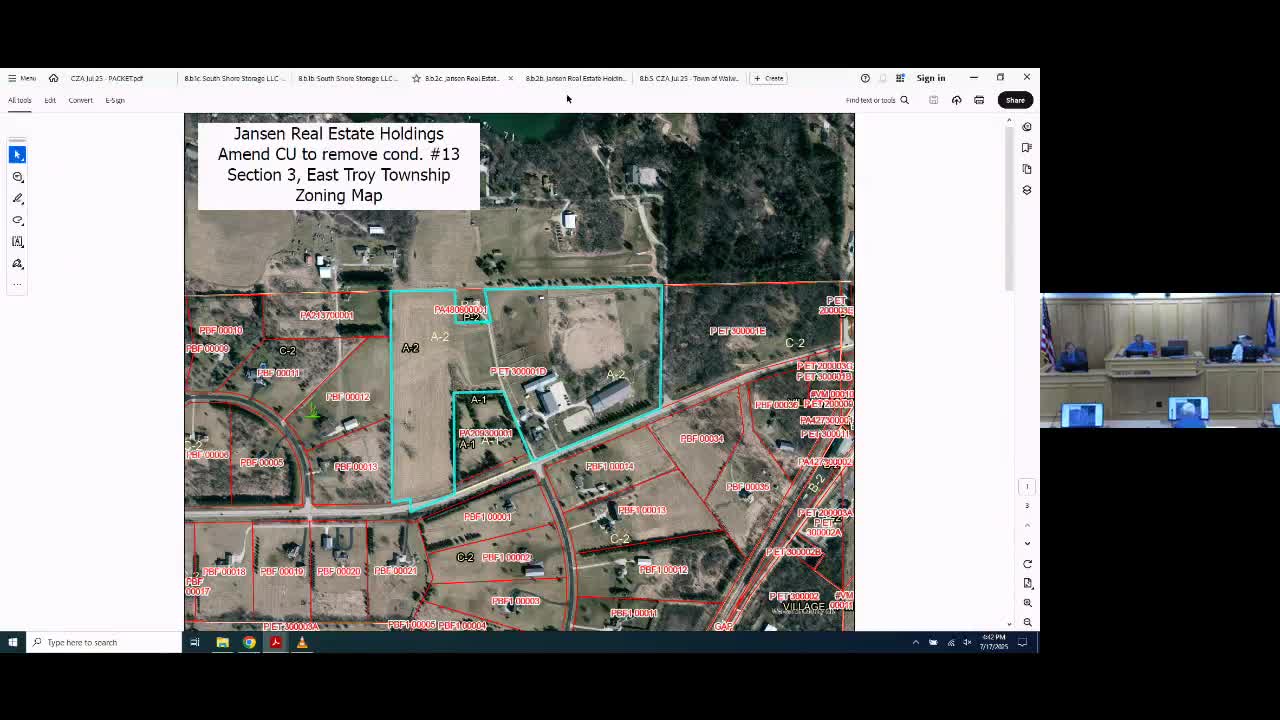
Summary
County zoning staff demonstrated drone capabilities for site overlays, enforcement and public works, and discussed related costs, training, privacy concerns and planned software investments.
Walworth County zoning staff demonstrated a county-owned drone and described how the technology is used for site plan overlays, enforcement checks and public-works surveys, and told the Zoning Agency the county will pursue related software and hardware upgrades.
Staff said the drone is flown by a certified pilot for permitted county work, and showed examples including overlays for proposed solar arrays, gravel pits and a recent Tomala site review. Kate, a Zoning Department staff member, said the visuals help agency members and the public “see what you’re getting” when the county asks for technology funding.
Agency members were given a short video tour and an outdoor demonstration. Chris, the county’s certified drone pilot, described operational limits and precautions: “The transmission distance is, like, 3 miles, but stick within, like, a generally, a 40‑acre field,” he said, adding that pilots should maintain line of sight and often use a spotter. He also confirmed the current aircraft has obstacle avoidance turned on.
Officials said they have used drone footage to reduce staff safety risks during enforcement (for example when property occupants are known to be threatening or potentially armed), to review gravel-pit operations and lake-district requests, and to create accurate site-plan overlays when evaluating projects. Mandy, a department staff member, said the drone work has sometimes helped other county departments such as public works assess sedimentation basins and maintenance needs.
The demonstration included technology context: staff use ArcGIS Pro (referred to in the meeting as ArcPro) to overlay proposed site plans on aerial imagery, and said that capability improved decision-making at hearings. Kate credited county GIS for licensing and said the department has “piggybacked” on that work to get better maps for meetings.
Speakers discussed costs and procurement choices. Staff said the current drone unit cost about $9,500 and that the county is evaluating future models with zoom capability and quieter propellers. For software and systems, staff reported current annual maintenance at roughly $36,000 and estimated that moving the permitting and geospatial system to a cloud-hosted, vendor-managed configuration could raise annual costs to about $90,000–$100,000; staff said higher-performance laptops that run ArcGIS Pro smoothly cost roughly $3,000 each. Kate said those technology investments were presented to and approved by finance and the county board in prior steps.
Agency members raised privacy and use questions. Officials said the county does not charge private parties for ad-hoc drone requests unless the scope becomes burdensome, and that when requests would impose on staff capacity they refer citizens to private drone firms. Mandy said, “we want to walk the line of not being in the business of providing drone service” as a county contractor. Staff also said they avoid low-altitude loitering and will not use the drone in a confrontational way if they expect an unsafe reaction from property occupants.
The demonstration concluded with an offer to coordinate further use: staff said they can accept requests from other county committees and will continue to develop procedures (for example using quieter propellers, different sensors or higher-end cameras) and training for pilots.
County staff emphasized that the drone program supplements existing review tools rather than replaces site visits or formal processes. The agency did not take a formal vote during the demonstration; staff said they would bring any future procurement proposals, training policy updates or budget requests back to the committee for approval.
Ending: The county left the drone on display for members to inspect and indicated staff will return to the committee with specific budget requests if they pursue higher‑end equipment or cloud-hosted software hosting.