Get Full Government Meeting Transcripts, Videos, & Alerts Forever!
Get email alerts on the Conservation Programs topic
No spam. Unsubscribe anytime.
Walworth County board backs continuation of Knowles-Nelson Stewardship Program; supervisors urge vigilance on state discussions
Summary
The board unanimously supported a resolution backing continuation of the state Knowles-Nelson Stewardship Program and several supervisors urged monitoring of related state-level proposals and potential local impacts.
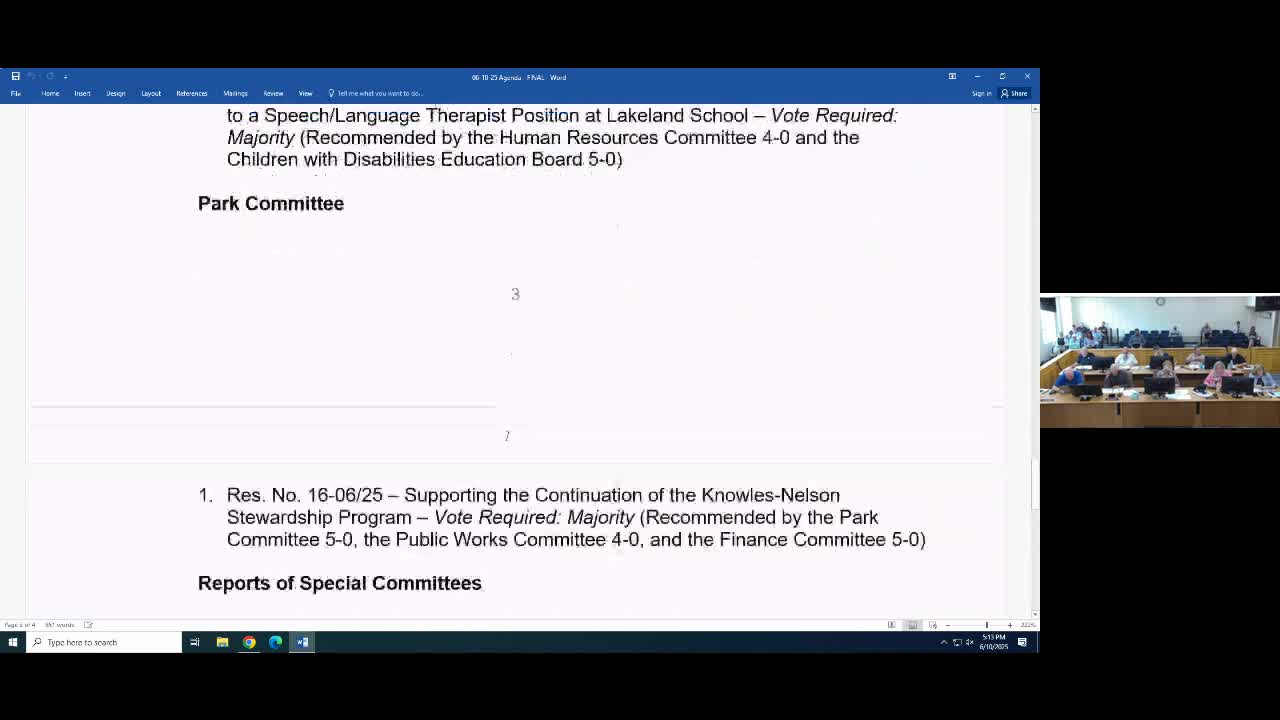
The Walworth County Board of Supervisors on June 10 approved a resolution supporting continuation of the Knowles-Nelson Stewardship Program, a Wisconsin state conservation grant program, and several supervisors noted possible local implications if state-level changes are adopted.
The resolution (16-6-2025) was recommended unanimously by the Park Committee (5-0), the Public Works Committee (4-0) and the Finance Committee (5-0). Supervisor Brian Holt, who said he voted for the measure in the Finance Committee, urged colleagues to watch developments in Madison and noted questions about how stewardship-authorized state land would operate in counties that have different park and forest holdings.
Holt described a scenario in which state stewardship could change local land ownership or management: “If they have a huge forest, the state can take over state land. There's no taxes collected on that state land. There are county departments responsible for maintaining, you know, cutting down trees and all that... but it's our land and the way it's set up as our parks, but this would be state land where I need to be responsible for maintaining.”
Supervisor Joanne Lisonbee asked about statewide cost implications; no specific dollar figures were provided in the county board discussion. The board approved the resolution by voice vote on a consent motion.
The transcript indicates the county's approval is an expression of support; any actual changes to local land ownership, maintenance responsibilities or tax treatment would depend on actions at the state level and separate agreements or grants.