Get Full Government Meeting Transcripts, Videos, & Alerts Forever!
Get email alerts on the County Budget topic
No spam. Unsubscribe anytime.
County officials warn state, federal budget changes could raise HHS costs and disrupt services
Summary
Walworth County Health and Human Services staff outlined state and federal budget changes — including a gubernatorial line-item veto on juvenile corrections rates and proposed SNAP/Medicaid cost‑share changes — and described potential local cost impacts, cuts to children’s grants and planning assumptions for the 2026 county budget.
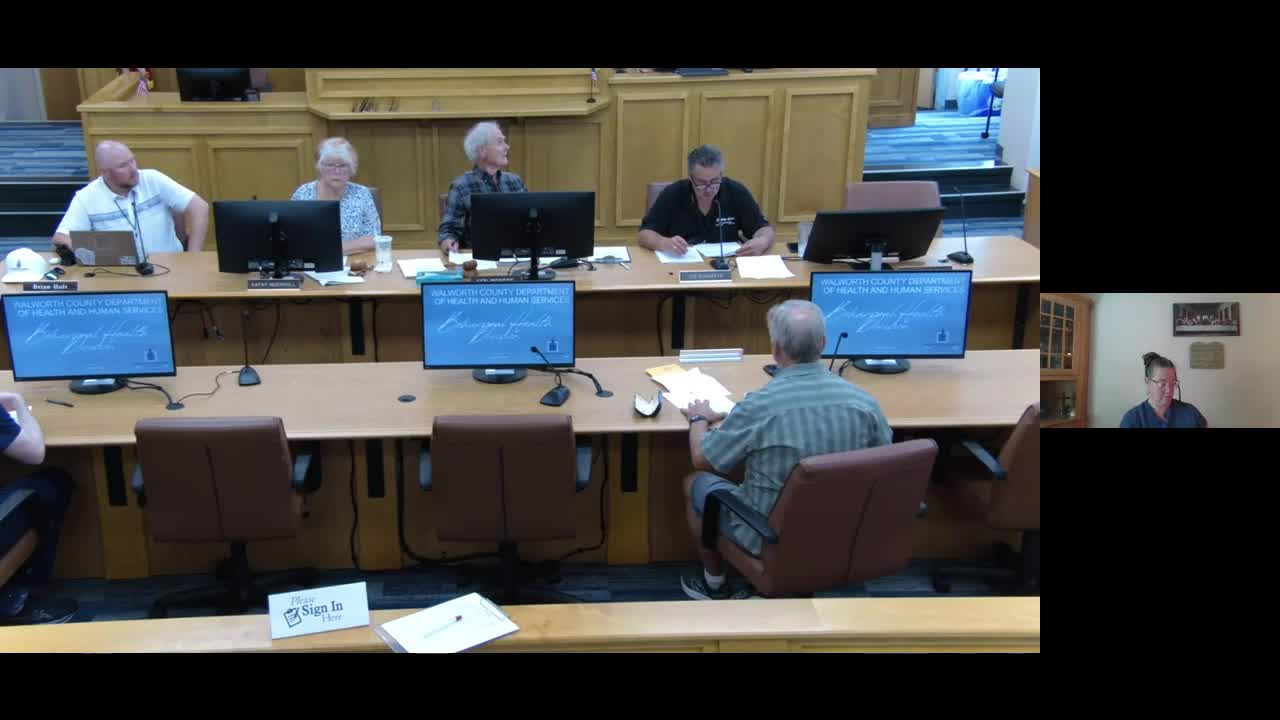
Carlos, an HHS staff member, told the Walworth County Health and Human Services Board on July 16 that a recent state budget action and proposed federal changes create uncertainty for county programs and could increase costs to the county. He described a series of state and federal items that he said county staff are watching closely.
Carlos said Gov. Tony Evers used a line‑item veto to reduce a proposed juvenile corrections daily rate that had been set at $2,501 per day; after the veto the rate will be $501 per day in the first year of the biennium and will rise to roughly $700 per day in the second year. “That gives us a two‑year reprieve,” he said, adding that the county has not budgeted for youth correctional placements in 2025 and that the original proposed rate would have been “closing down a million dollars to treat one kid.”
The board was told why the veto mattered locally: counties that historically used youth correctional placements would have received higher state aids under the original distribution, while counties without such placements — like Walworth — had allocations reduced. Carlos said the county faces about $200,000 in reduced children’s services grant funding because of those recalculations.
The presentation also covered federal changes to SNAP and Medicaid enrollment rules and cost shares. Carlos said the federal proposal would expand work requirements for SNAP and add work requirements to Medicaid for people ages 19–64. He told the board that SNAP administrative and benefit cost‑shares paid by states are expected to rise and that the state currently passes those costs through to counties. “If the state does not keep counties whole, it’s somewhere in the neighborhood of $250,000 to $500,000 a year, depending on how they calculate it,” he said, and estimated a potential county budget impact in 2026 of $62,000 to $125,000 in one scenario.
Board members asked about advocacy. Carlos said the Department of Health Services (DHS) has asked counties to join them in urging the state to protect county funding and that Walworth County may coordinate with the Wisconsin County Human Services Association. “They’re asking for us to also help advocate for that,” Carlos said.
Other budget items noted by staff: an increase in the county’s aging and disability resource allocation that the staff estimated would yield about $30,000 locally; a modest 2.5% foster care and kinship care rate increase (about $10,000 locally); and state funding for the 988 crisis line that may lower local emergency mental‑health call volume. Carlos also said staff expect continued ambiguity about how proposed SNAP/Medicaid rule changes will play out and that the county’s 2026 HHS proposed budget currently does not include funds to backfill a state shortfall.
Why this matters: county staff said these changes could force staffing reductions, program cutbacks or midyear budget adjustments if the state does not continue to pass funds to counties as it has historically. Board members asked staff to monitor developments and to return with requests for formal support if needed.
Board action and next steps: there was no formal board vote tied specifically to the budget briefing. Staff said they will continue to track the items, coordinate with DHS and the statewide association, and bring proposed budget adjustments back to the board if necessary.