Get Full Government Meeting Transcripts, Videos, & Alerts Forever!
Get email alerts on the Erv Ducts Opinion topic
No spam. Unsubscribe anytime.
MBPE issues opinion: ERV intake/exhaust ducts may remain outside conditioned space; ducts and HVAC push equipment must be inside
Summary
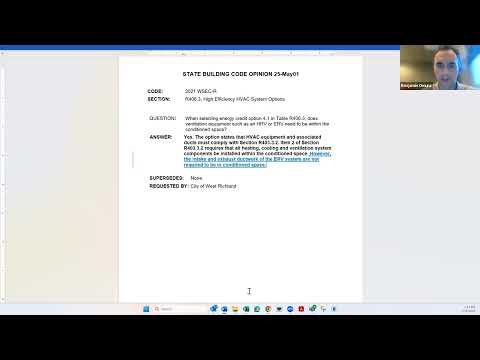
The MBPE committee on July 18 adopted a staff opinion clarifying that ducts and HVAC “push” equipment must be located inside the conditioned space to receive R406 credits, but intake and exhaust ductwork for ERV/HRV systems need not be inside the conditioned space.
The MBPE committee on July 18 approved a staff opinion clarifying how ERV/HRV ductwork is treated under the residential energy code.
The committee's opinion says ducts and all HVAC “push” equipment must be located within the conditioned space to qualify for the R406 credit; however, the intake and exhaust duct runs that serve energy recovery ventilators (ERVs) and heat-recovery ventilators (HRVs) are not required to be inside the conditioned space. The committee voted to adopt the opinion and issue it to the City of West Richland, which had requested guidance.
Why it matters: The residential R406 credit is tied to placing distribution equipment where it is insulated and within the building’s thermal enclosure. Building officials, designers and contractors sought clarity about whether ERV/HRV intake and exhaust runs had to be inside conditioned space to earn credits. The committee’s ruling narrows that requirement to the HVAC “push” equipment and ducts but leaves room for intake/exhaust runs to cross unconditioned areas.
How the discussion unfolded: Staff presented the draft opinion and said the change reflected the tag’s earlier intent. Committee member Ben said the published code text (R403.3.2) already limits how much supply and return ductwork may run outside conditioned space, so the opinion should be consistent with that section. Committee members opened the item to public comment.
Industry concerns and follow-up: Larry Andrews (Andrews Mechanical) asked whether exhaust ducts that pass through unconditioned space should be required to be insulated because moist exhaust air can condensate. Larry: “I think that duct should be clarified that that duct should have some insulation on it.” Krista (staff) and Kjell (committee) said the opinion itself addresses only location, not installation details such as insulation, and that the code’s existing duct installation and exhaust-fan rules would govern insulation if required. The group discussed consulting SMACNA guidance and the code office for a definitive reference. Staff said the opinion could be posted now to meet the request from West Richland and then revised later if additional code references or industry guidance (for example, SMACNA or specific code sections) show insulation is required.
Action taken: The committee voted to adopt the opinion as drafted (the motion carried) and to issue it to the requester; the committee also directed staff to seek additional references (SMACNA / code sections) for a follow-up clarification if appropriate.
What the opinion does not change: The opinion does not alter the R406 or R403 code text itself; it is a committee interpretation clarifying how the existing code is applied. Committee members explicitly distinguished the opinion (an interpretation) from a rule change.
Next steps: Staff will publish the opinion and, if new code references are identified, return a revised interpretation at a later MBPE meeting so the opinion can reference any specific requirements for insulation or condensate management if those are found to apply.