
State, university and local partners present watershed monitoring results and conservation planning options for North Depoe Bay Creek
Get AI-powered insights, summaries, and transcripts
Subscribe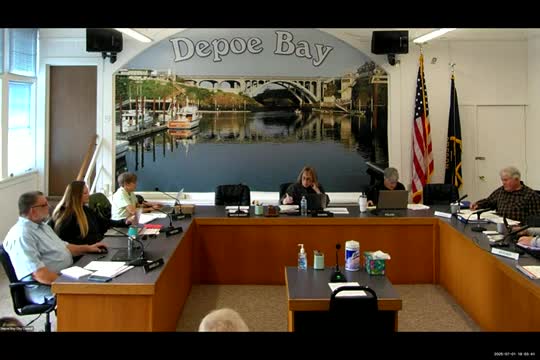
Summary
Oregon Department of Environmental Quality and Oregon State University researchers reported new streamflow sensor data, modeling results and drone imagery for the North Depoe Bay Creek watershed and described grant and technical assistance options to support land-conservation steps to protect Depoe Bay's drinking water supply.
City officials heard detailed findings and next steps on watershed monitoring and land-conservation planning for North Depoe Bay Creek during a guest presentation at the council meeting.
Oregon Department of Environmental Quality Drinking Water Protection Program staffer Laura (last name not specified) said the work began in 2023 after conversations with council members and city public-works staff about future water-quantity risks and the city’s limited control over land-management decisions in the source watersheds. "I work with the Drinking Water Protection Program with the Oregon Department of Environmental Quality. I started working with City of Depoe Bay in 2023," Laura said.
Dr. Meghna (last name not specified), an Oregon State University researcher working on hydrologic modeling, described installation of a streamflow sensor on North Depoe Bay Creek, use of calibrated watershed models and drone surveys to refine land-cover data. Meghna said the monitoring showed roughly 790,000,000 gallons of streamflow into the reservoir from October through May of the reporting period and explained how a calibrated model changes estimates of infiltration, return flow and sediment delivery compared with an uncalibrated default model.
Why it matters: the city’s reservoir and treatment system depend on sustained base flow and low sediment loads. The presenters said better data and calibrated models make it possible to prioritize parcels and practices for protection or restoration and to estimate benefits from potential conservation investments.
What presenters reported - Installed sensor and early data: City and university teams installed a flow sensor on the main tributary feeding the reservoir to provide ground-truth data for modeling and to give students hands-on monitoring experience. Meghna said the sensor allowed comparison of hourly and daily flows and detection of storm peaks and seasonal variability. - Modeling approach and calibration: With no local long-term gauge, the team calibrated a SWAT hydrology model for a nearby gauged watershed judged most similar to North Depoe Bay Creek, then transferred calibrated parameter sets to the Depoe Bay model. Meghna described improved model performance after calibration and noted ongoing work to further align model output to the gauge at Depoe Bay now that monitoring is in place. - Drone land-cover mapping: The team conducted multispectral drone surveys in 2025 to update 2023 satellite land-cover inputs and identified areas of recent deforestation inside a polygon that was forested in earlier imagery, which could raise sediment yield when updated in the model. - Sediment and priority areas: Model outputs map subwatersheds that contribute disproportionately to sediment delivery and high runoff; presenters said these maps can guide targeted landowner outreach and conservation easement priorities. - Funding and technical assistance: Laura said the project combined grants and technical support from the Oregon Health Authority (OHA), a pilot from the U.S. Environmental Protection Agency administered through Sustainable Northwest, and university modeling. She noted a prior OWEB (Oregon Watershed Enhancement Board) biennial grant program had set aside $5,000,000 for small public water systems serving fewer than 10,000 people; the most recent biennium’s funding round closed without a new allocation and advocates are seeking renewed funding.
Council and staff next steps described in the meeting included continuing the monitoring and modeling work, using the new maps to prioritize parcels for outreach and developing a local landowner engagement strategy so the city is ready when state funding opportunities reopen. Laura and Meghna emphasized that having prioritized parcels and supporting analysis strengthens future grant applications.
Quotes from the presentation - "I work with the Drinking Water Protection Program with the Oregon Department of Environmental Quality. I started working with City of Depoe Bay in 2023," Laura said while introducing the project and partners. - "Until May earlier this year, we had about 790,000,000 gallons of water that had come from North Ecobic Lake Creek into the reservoir," Meghna said, describing sensor totals captured to date.
What was decided and what remains open - The council heard the presentation and later a separate agenda motion (recorded elsewhere on the agenda packet) proposed funding for additional OSU work on land-conservation planning; the transcript records the motion but does not record a roll-call vote in the excerpt provided, so the formal outcome of that motion is not specified in the segment of the record. - Presenters and staff said the technical work will continue and that targeted parcel outreach should be prepared so the city can move quickly when state or private funding is available.
Ending: City staff said they will continue to coordinate with the DEQ, OSU and Sustainable Northwest on monitoring, modeling and landowner outreach. Presenters urged the city to assemble prioritized parcels and supporting analysis to be ready for future grant cycles.