
Depoe Bay agrees to apply for state hydrogen backup grant; staff seek details on footprint and operations
Get AI-powered insights, summaries, and transcripts
Subscribe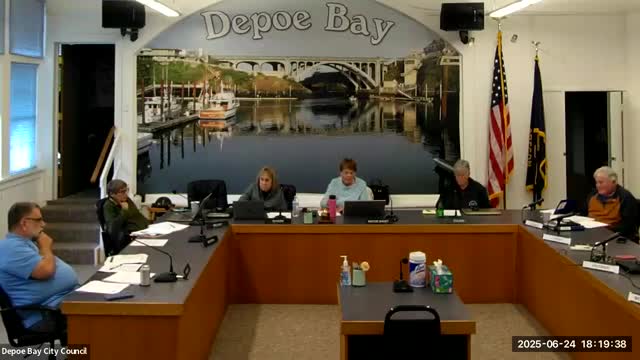
Summary
Councilors gave consensus to apply for a state energy grant to install hydrogen backup systems at the community center (and later at the water/wastewater plant). Staff and public raised questions about container size, earthquake safety, maintenance, staffing and long‑term operations; consultant work and a seed budget were discussed.
Depoe Bay councilors agreed by consensus at a June 24 work session to move forward with an application for an Oregon energy grant that would fund on‑site hydrogen backup systems for city facilities, while staff flagged follow‑up questions about siting, maintenance and long‑term operations.
What council agreed to consider
City staff described a two‑phase grant opportunity: an initial phase to install hydrogen‑fuel systems at two municipal sites (the meeting referenced the community center and one other facility) and a later phase for additional systems such as the water/wastewater plant. A consulting firm (Aptum, referenced in the discussion) is available to prepare the application; the council agreed that consultants should begin work so the August/September letter‑of‑intent window can be met.
Grant details, footprint and operations concerns
Staff said the installed unit is a containerized system roughly described in the discussion as about 20 by 10 feet with solar arrays on or near the container and fuel tanks inside. Presenters said the system is intended to provide emergency power for extended outages and that the company providing the system (described as based in Boulder, Colorado) will provide technical and seismic performance data; DEQ/DOE grant guidance requires applicants to describe operations, staffing and maintenance for at least five years.
Council members and city staff asked practical questions: where tanks would be sited, whether trees would need removal for the footprint, who would perform maintenance, whether staff have capacity to operate and inspect the system, and how the city would address zoning and permitting. Staff noted the grant application itself asks for an operations and staffing plan and a budget impact projection for annual maintenance.
Funding, timeline and city costs
Presenters said the grant process is competitive but that the city would not need to contribute capital for initial construction if awarded; the grant has two phases, with an initial construction phase figure discussed (the conversation referenced a $95,000 initial figure in earlier materials) and a later phase up to roughly $1,000,000 for larger deployments. City staff said the city has budgeted $25,000 as seed money to pay consultants to assemble the application and supporting documents.
Next steps and staff tasks
Councilors asked for more technical briefings from the vendor and for written answers to site‑specific questions (seismic testing, maintenance training, staffing and emergency procedures). Staff said the consultant can begin application work immediately and that formal council approval of the application will be scheduled at the next council meeting; staff will also check zoning and permitting requirements and follow up about whether the system will require a building permit, screening or tree removal.
Ending
Council consensus to pursue the grant cleared the path for the consultant to start application work; staff will return with vendor responses to seismic and operations questions, a final application for council approval and recommended site plans and permit next steps.