
Hays approves CDBG application to rehab downtown second floor for short‑term rentals
Get AI-powered insights, summaries, and transcripts
Subscribe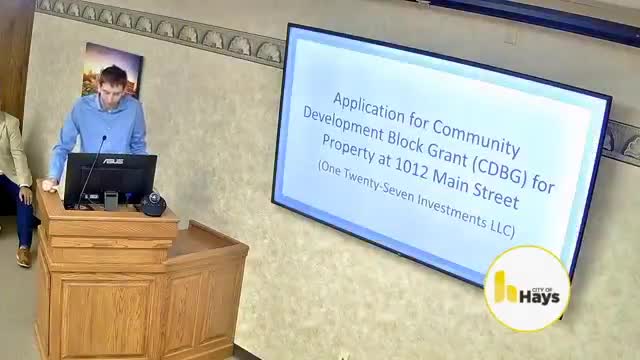
Summary
The City Commission approved sponsoring a $300,000 Kansas CDBG commercial rehabilitation application from developer 127 Investments to renovate the long‑vacant second floor at 1012 Main Street into three short‑term rental units; commissioners also adopted resolutions certifying legal authority and declaring the building blighted.
The City of Hays Commission voted 3‑0 on June 26 to sponsor a Community Development Block Grant (CDBG) application from 127 Investments to rehabilitate the second floor at 1012 Main Street into three rentable short‑term units.
The matter matters because the CDBG commercial rehabilitation program provides targeted funds to prevent or eliminate commercial blight; if awarded, the state Department of Commerce would send grant funds to the city and the developer would implement the renovation and request reimbursements through the city.
Jared Kuckelman, Assistant City Manager, told the commission the application seeks the commercial rehab maximum of $300,000 and requires a minimum 25% match from the developer. “For small cities like Hays that have a population less than 50,000, CDBG is administered by the states,” Kuckelman said, adding that commercial rehab grants focus specifically on blight prevention rather than low‑ and moderate‑income housing requirements.
During the public hearing, resident David Koshel urged the commission to avoid using federal CDBG funds for short‑term rentals, saying the program should prioritize housing for residents. “These are federal dollars being funneled through the city to help a private investor build short‑term rentals, not homes for families,” Koshel said.
Brett Wagner, a grant writer and the project’s grant administrator, explained the CDBG national objectives to the commission: projects generally must either benefit low‑ and moderate‑income persons or eliminate/prevent commercial blight. “The second national objective is to eliminate or prevent the spread of blight in commercial areas. That's what this program is aimed for,” Wagner said, and he noted that Hays as a whole does not qualify as a low‑ to moderate‑income community without a time‑consuming survey process.
Developer Tim Spino, owner of 127 Investments, said the building’s second floor has been vacant for decades and that the grant would allow the project to proceed sooner. “Without this grant, I would not be able to do the development at all,” Spino said, adding that the ground‑floor tenant, Eclectic Threads Quilt Studio, would remain.
Doug Williams, executive director of Grow Haze, urged the commission to support keeping grant dollars in Hays: “If we don't get it, somebody else is going to. ... I'd much rather it be spent in Hays than somewhere else.”
The commission approved three motions tied to the application: (1) to enter an interlocal agreement and a personal guarantee and to sponsor the CDBG application; (2) to adopt Resolution No. 2025‑007 certifying the city's legal authority to apply and authorizing the mayor to sign necessary documents; and (3) to adopt Resolution No. 2025‑008 declaring the building blighted for purposes of the application. All three passed 3‑0.
If the grant is awarded, Kuckelman said the state notifies applicants about 45 days after submission; as the sponsor, the city would receive funds and disburse them to the developer following state rules and city approval. The required 25% match would be provided by the developer, and no city general‑fund dollars would be distributed to the project under the plan presented.
The commission closed the public hearing before voting and invited staff to proceed with the July application submission.