
City traffic engineer says six studied intersections do not meet national signal warrants; staff and council weigh safety, costs
Get AI-powered insights, summaries, and transcripts
Subscribe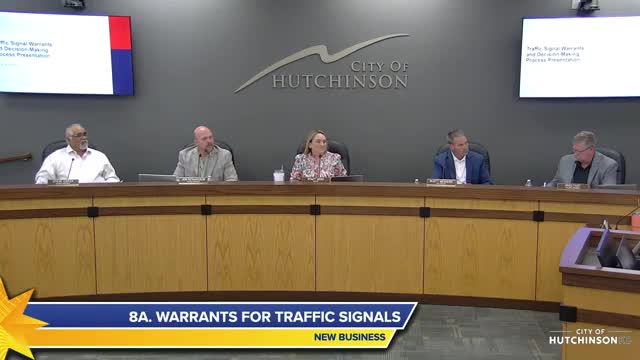
Summary
A traffic engineer told the Hutchinson City Council on July 1 that six intersections studied in the city do not meet national signal‑warrant thresholds and that maintaining unwarranted signals can raise crash risks and long‑term costs.
A traffic engineer told the Hutchinson City Council on July 1 that six intersections studied in the city do not meet national traffic-signal warrant thresholds and that maintaining unwarranted signals can raise crash risks and long-term costs.
The study by Patrick Bird of JEO Consulting Group analyzed three “Group 1” intersections on Fourth Street (Fourth & Washington, Fourth & Walnut and Avenue A & Washington) and three “Group 2” locations (20th-Third & Tyler, Bigger & Maple, and Eleventh & Baker). Bird said none of the sites satisfied MUTCD (Manual on Uniform Traffic Control Devices) warrants for signal installation or continued signal control and recommended removing unwarranted signals and using stop control where appropriate. “This is a national standard that’s published by FHWA,” Bird said of the MUTCD guidance, and he emphasized that satisfying a warrant “doesn’t necessarily mean that the installation of a signal… goes in” — the warrant is guidance, not an automatic order.
Why it matters: City staff said removing unwarranted signals could reduce certain crash types and save long-term maintenance dollars. Bird cited a study summarized by the National Cooperative Highway Research Program showing removal of unwarranted signals reduced overall crashes by 24% and injury crashes as much as 53% in before/after comparisons. He also told the council that a new traffic signal can cost $300,000–$500,000 to install and typically $6,000–$8,000 per year to maintain; over a 30-year life those maintenance costs can add roughly $180,000–$240,000 beyond initial installation, not counting replacement after collisions or knockdowns.
Study findings and local data: Bird said warrant 1 (the 8‑hour volume warrant), warrant 2 (the 4‑hour/peak warrant) and the pedestrian warrants produced few or no hours meeting the MUTCD thresholds at the studied locations. He gave intersection crash totals for 2020–2024: Fourth & Walnut 21 crashes (about 62% rear‑end), Fourth & Washington 11 crashes (about 55% rear‑end), Avenue A & Washington 3 crashes, Maple & Bigger 1 crash and Eleventh & Baker 8 crashes (about half involved red‑light running). Bird reported 20th‑Third & Tyler had no crashes in the five‑year window.
Council and technician concerns: Several councilmembers and a senior traffic signal technician employed by the city raised objections to blanket removals, noting local conditions. The technician, who identified himself only as a senior signal technician with 30 years’ city experience, said removing signals at Fourth & Washington could create safety problems near an older adults’ facility north of the intersection and argued the city could put signals on semi‑actuated operation or use cameras to reduce unnecessary operation. “They’re not bothering anybody… I don’t buy that as a traffic signal technician,” he said, urging caution on removal. A council member noted some studied intersections sit near elementary schools and asked staff to coordinate any removals with planned school‑zone flashers.
Staff notes, process and next steps: City staff told the council two Fourth‑Street signals previously discussed were already “bagged” (covered/disconnected) and scheduled for physical removal in September; the presentation was informational and no action was requested at the July 1 meeting. City engineers said decisions will include engineering judgment about sight lines and pedestrian needs; Bird noted the school‑crossing warrant requires at least 20 pedestrians in a peak hour, which none of the school‑adjacent locations met in the collected counts.
What the council could decide later: Staff suggested alternatives to removal where warranted, including keeping a signal but converting it to semi‑actuated operation, installing push‑button pedestrian recall, or using four‑way stop control if sight lines allow. Council members asked for more public education about the warrant process before any additional removals and for staff to coordinate with school flashers planned for this year.
Ending: The presentation closed as informational; no new council motion or vote occurred on July 1. Staff said they will continue counts, review crash history, coordinate school‑zone flashers and follow up with council before taking further removal actions.