
Terre Haute council rejects rezoning for Fruit Ridge–Ohio Boulevard development
Get AI-powered insights, summaries, and transcripts
Subscribe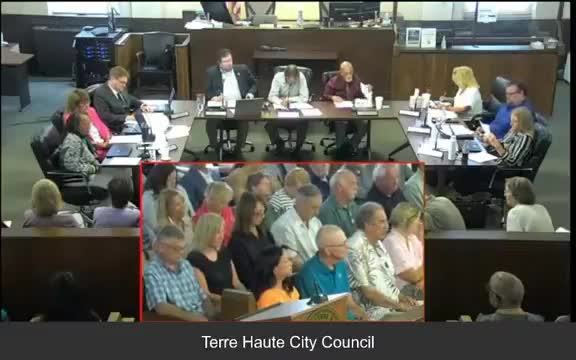
Summary
The city council voted 7–2 to deny a rezoning request that would have allowed a mixed single‑family and multi‑family development at 501 and 601 South Fruitridge; related redevelopment and tax‑increment financing items were tabled to Aug. 7.
The Terre Haute City Council voted 7–2 on Thursday to reject Special Ordinance 18‑20‑25, a rezoning request for property at 501 and 601 South Fruitridge that developers said was needed to build a mixed project of single‑family homes and multifamily apartments adjacent to Ohio Boulevard and Deming Park.
The matter drew more than three hours of public comment and testimony from neighborhood residents, preservation advocates, county officials and business groups. Supporters said the project would add housing supply and help attract employers; opponents said the plan would harm the character of historic Ohio Boulevard, create traffic and infrastructure strain, and lacked sufficient public review.
Eddie Felling, attorney for the landowner and developers, framed the issue as a jobs‑and‑housing proposition. "I ask all of you as council members to focus on the facts when you go to make your decision this evening," Felling told the council, and said the developer had prepared a plan and a memorandum of understanding with the mayor committing the parties to the presented project. Felling later added, "The MOU contractually binds us to the project we've presented."
Supporters included Mark Lincoln, a Vigo County commissioner, who called the proposed $70 million development a rare, large local investment and said it would expand the tax base and support schools and infrastructure. Julie Hart of Thrive West Central cited the group's market analysis showing regional demand for housing, and Kristen Craig, president and CEO of the Terre Haute Chamber of Commerce, urged approval as part of a strategy to increase population and retain workers.
Opponents included Tommy Kleckner of Indiana Landmarks, who said the project as proposed "disregards the context and development patterns of the boulevard" and argued the site would be better served by single‑family development more sympathetic to Ohio Boulevard and Deming Park. Several long‑time residents and neighborhood organizers testified that the project would reduce historic character and generate traffic and safety concerns; Susan Gore, who lives at the corner of Fruitridge and Ohio, told council members the traffic study did not reflect morning rush conditions and said trains and event traffic already cause backups.
Speakers disputed technical points in the developer's materials. Former councilman Earl Elliott presented market and occupancy figures he gathered, saying seven nearby apartment complexes totaling 1,793 units had only 10 vacancies — a 99.4% occupancy rate — which he said indicates strong local demand for housing. Residents and speakers also pointed to an estimated increase of 2,066 daily vehicular trips in the area once the development is occupied, a figure raised during public comment.
Council members heard that the developer and the city executed a memorandum of understanding that would tie certain commitments — sidewalks, trail easements, adherence to the submitted road and site plans and other elements described in the MOU — to the approvals. City legal counsel confirmed on the record that the MOU is a contractual instrument the city could enforce. "The document clearly defines what representations are being made by the developer and clearly defines what representations are being made by the city," the city attorney said.
After council discussion, Councilman George Chalos moved to approve Special Ordinance 18‑20‑25; Councilperson Chelsea Loudermilk seconded. The roll call vote was: Loudermilk and Chalos — yes; Thompson, Hinton, Dingle, DeMann, Boland, Azar and Nation — no. Council staff recorded the outcome as 2 yes, 7 no; the ordinance failed.
Related redevelopment items tied to the project were addressed in two separate resolutions: Resolution 13‑20‑25 (creating an economic development area and an ordinary TIF allocation area for the Brickyard/"Paddock at the Park" site) and Resolution 14‑20‑25 (an amendment establishing a single‑family housing allocation area). Councilman Dinkel moved to table both resolutions to the council's Aug. 7 meeting; the motions were seconded and the items were tabled.
Throughout public comment and in council discussion, speakers emphasized limited development alternatives in the immediate parcel and the risk that, if the rezoning failed, the property owner could sell the land and it could be developed under existing R‑1 rules without further council review. The mayor and developers said other housing projects are underway elsewhere in the city and that failing this particular rezoning would not remove all housing options in Terre Haute.
With the rezoning defeated and TIF resolutions delayed, the council left the door open for further negotiation, revised proposals or different project designs. The developer and city have said they and the redevelopment commission will continue to engage stakeholders; councilmembers who voted against the rezoning said earlier in debate they wanted more information or changes to the plan before approving a zoning change that opponents said would be irreversible in its effects on the historic boulevard.
Votes at a glance: Special Ordinance 18‑20‑25 (rezoning for 501 & 601 South Fruitridge): moved by Councilman George Chalos; seconded by Councilperson Chelsea Loudermilk; roll call 2 yes, 7 no — ordinance failed. Resolution 13‑20‑25 (economic development area/TIF allocation): motion to table to Aug. 7 by Councilman Dinkel; seconded by Councilperson Boland — tabled. Resolution 14‑20‑25 (TIF amendment/single‑family allocation): motion to table to Aug. 7 by Councilman Dinkel; seconded by Councilperson Thompson — tabled.
What happens next: The council will revisit redevelopment and TIF matters at its Aug. 7 meeting. Developers said the MOU and TIF steps were intended to secure financing and to bind project commitments; opponents said the council should demand more rigorous traffic, environmental and planning review and stronger design standards to protect Ohio Boulevard and Deming Park. The developer can revise the proposal or withdraw it; if no rezoning is approved and the owner sells the land, future outcomes would be governed by existing R‑1 zoning unless and until the council votes otherwise.