Get Full Government Meeting Transcripts, Videos, & Alerts Forever!
Get email alerts on the Traffic Calming topic
No spam. Unsubscribe anytime.
Council considers lowering petition threshold for traffic-calming requests; members push to add speed-bump funding in fall budget
Summary
City staff introduced an ordinance amendment to lower the neighborhood petition signature threshold for traffic-calming requests from 75% to 60%. Council members said the city should budget money to pay for speed bumps, noting poor neighborhoods often cannot self-fund traffic-calming measures.
The City Council on July 8 heard a staff briefing and initial introduction of an ordinance to amend the city’s neighborhood traffic-calming procedure, lowering the petition signature requirement from 75% to 60%.
The change was recommended by the traffic-calming committee, reconstituted as a subcommittee of the planning board, which told staff it considered 75% too high a barrier for neighborhoods seeking traffic-calming measures.
Terry Williams of the city attorney’s office explained the amendment is intended to lower the signature threshold to 60% to make it easier for neighborhood associations to bring forward self-funded traffic-calming projects. Planning and legal staff said the committee had only been recently reactivated and made the recommendation after meeting with neighborhoods.
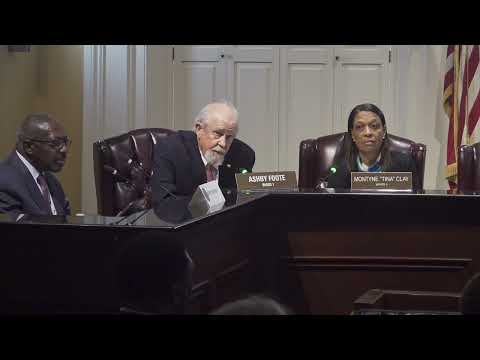
Council members moved the conversation to funding. Councilman Foote asked whether the city would consider allocating money in the upcoming budget to pay for speed bumps and other calming devices so low-income neighborhoods would not have to self-fund construction. Councilman Hartley and others supported adding line items to the August budget deliberations or using fund balance money to ensure equitable distribution of traffic-calming installations.
Staff noted an additional practical consideration: the traffic-calming ordinance requires a traffic study that normally would be prepared by an in-house engineering division. Because the city currently lacks that capacity, the cost of hiring an outside engineering consultant for traffic studies would add to project expense.
No ordinance was adopted on July 8; this item was introduced and discussed. Council members asked staff to include a proposal for possible budget allocations and the estimated costs of consultant studies when budget deliberations begin.