
Sammamish planning staff brief commission after council directs study of 4,000‑unit town center alternative
Get AI-powered insights, summaries, and transcripts
Subscribe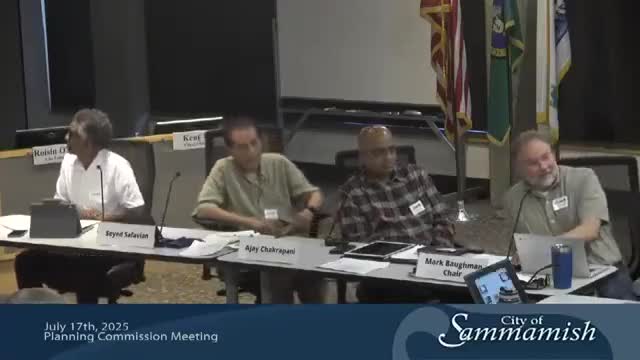
Summary
Sammamish City staff and their consultant briefed the Planning Commission on July 17 on the city council’s recent direction to study an “action alternative” that models up to 4,000 housing units for the Town Center, while work continues on the supplemental environmental impact statement and draft plan and code.
Sammamish City staff and their consultant briefed the Planning Commission on July 17 on the city council’s recent direction to study an “action alternative” that models up to 4,000 housing units for the Town Center, while work continues on the supplemental environmental impact statement and draft plan and code.
The presentation, led by David Pyle, Sammamish community development director, and Jeff Varango of consultant firm Framework, emphasized that the supplemental EIS (SEIS) is a disclosure tool under state law and that the study of up to 4,000 units does not itself authorize construction. “This is informational only,” Pyle told commissioners as staff described next steps including a final SEIS, a draft proposed plan, and follow‑on code work this fall and winter.
The SEIS study compares a no‑action alternative (about 2,000 units under earlier assumptions) with an action alternative that analyzes the potential environmental effects of a higher density outcome and associated changes to the plan, form‑based code and incentives intended to make mid‑rise and low‑rise housing types financially feasible. Varango said the action alternative is a planning‑level construct used to test impacts and that the actual build‑out could be lower or take decades: “the 4,000 is really a threshold for which we wanted to study,” he said.
Why it matters: commissioners and dozens of residents who spoke during public comment framed the discussion around three themes: public safety and evacuation; traffic and mobility; and environmental and fiscal risk. Speakers asked the commission to press staff and council for clearer data, visuals and fiscal numbers before legislative action. Several residents urged the commission to recommend delaying any final plan vote to allow more public review.
Public concerns and staff responses
Residents at the meeting, and hundreds of written commenters submitted during the SEIS comment period, said they fear traffic gridlock, loss of mature trees and insufficient infrastructure funding if the city proceeds with higher density in the town center. Debbie Train, a Sammamish resident, told commissioners she is “not against the development of the town center, but I am concerned that the city is not only granting variances to facilitate the development … but also spending taxpayer money to support the developer.”
Multiple residents cited transportation impacts. Loreen Leo described a long trip she made as evidence that current evacuation times are too long and asked the city to improve evacuation planning before approving higher density. Staff acknowledged the update: the city’s emergency management plan and the 2022 evacuation study are referenced in the SEIS materials and staff said evacuation times vary by scenario; staff described staged evacuation zones and said they will continue coordination with Eastside Fire & Rescue.
Traffic was the single most common topic in SEIS comments, staff said. Framework’s analysis uses standard trip‑generation inputs and a set of network scenarios; Jeff Varango reported the action alternative’s modeled average delay increase was small and that only one intersection (Southeast Eighth and 212th) was shown to exceed service thresholds in the scenario tested. Audrey Starcey, the city’s public works director, and staff said the draft transportation memo will be expanded to show assumptions and intersection‑level detail requested by commissioners and members of the public.
Environment, trees and infrastructure funding
Staff emphasized that the SEIS does not propose changes to the city’s critical‑areas rules or stormwater standards; Pyle said the proposal does not change how those rules apply. The draft plan does assume redevelopment of parts of the town center and staff said about 83 acres of critical areas would remain protected under current rules.
Residents pressed for stronger protections and for completion of complementary planning work before major changes: Debbie Train listed three items she said should be completed first—the urban forest management plan update, wildlife interface protections called for in the critical areas ordinance, and an updated transportation master plan with realistic costs and timelines. Residents also cited two figures they had found in city materials: a $31 million water and sewer cost cited for an early project phase (for roughly 2,000 units) and a $42 million transportation project estimate for 2025–2030, of which about $1 million was noted as funded; residents asked who will pay the remainder.
Affordability, code changes and timing
Staff said the town center work aims to increase housing diversity and affordability by aligning plan, code and incentives so mid‑rise and low‑rise product types are financially feasible. Varango and Pyle explained that incentive structures used in earlier versions of the plan (including transfer‑development rights and other bonuses) have been largely exhausted, and that code and entitlement changes are intended to reduce time and administrative cost and attract a wider range of developers.
Several residents asked the commission to recommend delaying further legislative steps to allow more public review. Jennifer Kim told the commission the changes would be a “one‑way door” and asked commissioners to table the discussion until August. Staff answered that the city will continue to accept comments on the draft plan and code until legislative action is taken and that commissioners will have another scheduled study session (August 7) to comment on a web‑based markup tool and a more detailed packet.
What commissioners asked staff to supply
Throughout the meeting commissioners requested clearer, more accessible materials for residents: renderings or before‑and‑after visualizations of likely public‑realm outcomes, a clearer breakdown of infrastructure costs and funding sources, an expanded transportation appendix showing intersection‑ and corridor‑level assumptions, and explicitly stated assumptions used to generate the SEIS land‑use capacity estimates. Staff agreed to expand the transportation memo, provide additional explanatory materials and to bring plan/coding edits forward for the commission’s review.
Next steps
Staff said the city will complete a final SEIS over the summer and issue an integrated draft proposed plan for the commission and council to consider. Code drafting and the legislative schedule are expected in late fall and winter and could extend into 2026 depending on the scope of revisions and public input. The commission set August 7 as its next, focused opportunity to review plan text and proposed code language and to provide formal recommendations to council.
Ending
Commissioners and staff acknowledged that dozens of residents attended and that the town center process will require technical study and clearer public communication. Commissioners asked staff to return with more transparent transportation analysis, cost breakdowns and visuals that explain likely design outcomes so the community can better evaluate tradeoffs before council action.