
Sammamish plan recommends level-of-traffic-stress targets, sidewalk and bike-lane dimensions
Get AI-powered insights, summaries, and transcripts
Subscribe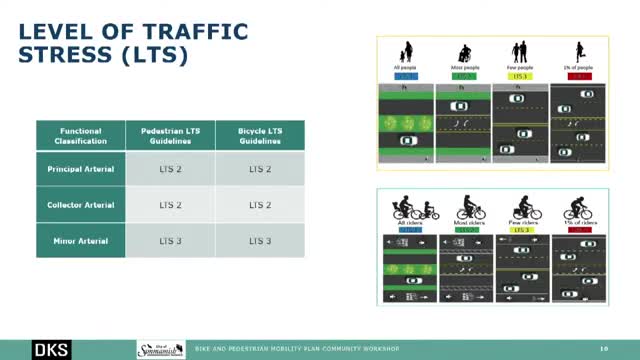
Summary
Consultants recommended level-of-traffic-stress (LTS) goals and facility standards—including 6-foot sidewalks with 5–6 foot buffers and separated bike lane designs on higher-speed roadways—to meet the city’s comfort-oriented goals for walking and biking.
City staff and consultants recommended facility standards tied to level-of-traffic-stress goals that aim to make most streets comfortable for a broad range of users. Wintana Miller of DKS described LTS as a 1-to-4 scale, with LTS 1 being comfortable for “all ages and abilities” and LTS 4 comfortable for only expert cyclists; the transportation master plan’s guideline is generally to target LTS 2 on arterials where feasible. For sidewalks, the workshop presentation recommended a 6-foot sidewalk with a 5- to 6-foot adjacent buffer on higher-speed roadways (35 mph and greater) to meet the LTS target; at 30 mph, a 6-foot sidewalk with a 5-foot buffer was identified as appropriate. For bike lanes, Miller said the guidance calls for a separated bike lane on 35-mph-plus roadways with a 6-foot bike lane, a 2-foot buffer and a vertical element (planter, curb or other physical separation). Conventional bike lanes of 5–7 feet with striping were described as appropriate on 25–30 mph streets with lower volumes; on very low-volume streets (under about 3,000 vehicles per day) the plan noted that mixed traffic may be appropriate and a dedicated bike lane may not be required. Consultants emphasized that these are design goals and that right-of-way constraints, costs and site conditions may make them infeasible at specific locations; project-level design will determine final treatments.