
City, school officials and residents discuss transferring vacant school properties to redevelopment authority
Get AI-powered insights, summaries, and transcripts
Subscribe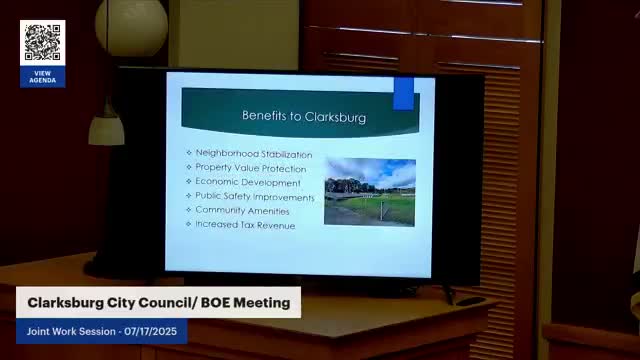
Summary
At a public meeting, city officials, Board of Education representatives and residents discussed placing vacant school properties into the city—s LRA to seek redevelopment funding, with questions raised about remediation, utilities, tax incentives and who would control future uses.
At a public meeting, city officials, Board of Education representatives and residents discussed proposals to move vacant school properties into the city's LRA (local redevelopment authority) to attract outside investment for housing, recreation and other projects.
The discussion matters because transferring surplus school properties could speed redevelopment, change who controls the sites and enable financing tools — such as tax incentives or bonds — that are not available to the city or school board acting alone.
Speakers outlined possible benefits and raised implementation questions. "Protect property values. It helps enhance community development. It also helps make our city a bit safer, provides community amenities, and help increase tax revenues," said Resident (Speaker 1). Board/education transfer logistics were discussed several times: one commenter said, "any property that would come from the board of education would not be subject to a weed. It would not. Then the process would be they would they would move it to the city. The city council would then move it to the..." (Resident, Speaker 1).
Council members and others pressed for details on the scale of the inventory and how properties would be marketed. "And who are these 11 to 14 — are the 11 to 14 properties? Are they now in our possession to be able to market, or are they still..." asked Council member (Speaker 2). The count of "11 to 14" properties and how many are under city control were discussed but not resolved in the meeting.
Health and cleanup liabilities came up when residents and board representatives referred to recent fires and aging building materials. "There's fires in a couple of schools, that was unfortunate, and our biggest concern, not only with the remediation and the cleanup, because a lot of the old buildings in our city have asbestos and land," said Resident (Speaker 1).
Officials and an education representative also discussed operating costs and program uses for redeveloped sites. An education representative (Speaker 3) asked about utilities and climate control costs for vacant buildings: "how much does that usually run?" Participants suggested redevelopment proposals could include multiuse fields and recreation space and that agreements could reserve some school access: "Maybe allot a certain percentage of time into the schools for what they need as well," said Resident (Speaker 1).
Several speakers described incentives and financing pathways. One participant explained why proponents favored the LRA: "the advantage of us putting something into the LRA is if we're looking for outside investment... LRA can take off debt," (Speaker 3). Participants mentioned sales-tax waivers and construction-cost incentives as possible inducements for developers, and that bond counsel and formal bond approvals would be needed if the LRA issues debt.
No formal motion or vote was recorded during this portion of the meeting. Multiple speakers asked for and supported continued discussion: "We'd like to, you know, within the next month or so, get together again and... see what you folks are thinking and go from there," said Council member (Speaker 3). Another participant closed the conversation by saying, "We will book it as a regular meeting" (Resident, Speaker 1).
Next steps identified in the discussion included further meetings between city staff, school officials and community members to clarify the inventory of surplus properties, remediation costs, financing options and any restrictions tied to school-donor or state requirements. Speakers repeatedly noted that detailed financing would depend on outside funding and legal review (bond counsel), and that final control of properties would depend on formal transfers and agreements between the Board of Education, the city and the LRA.