
MCPS reports modest gains in literacy and math but large gaps remain, will use state report card as strategic baseline
Get AI-powered insights, summaries, and transcripts
Subscribe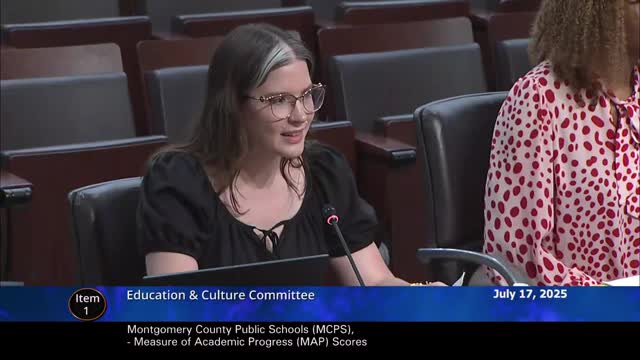
Summary
Montgomery County Public Schools officials briefed the County Council’s Education and Culture Committee on July 17 about the district’s academic performance trends and the rationale for switching the district’s public reporting to the Maryland School Report Card.
Montgomery County Public Schools officials briefed the County Council’s Education and Culture Committee on July 17 about the district’s academic performance trends and the rationale for switching the district’s public reporting to the Maryland School Report Card.
The presentation, led by Dr. Keshia Addison, Director of Shared Accountability for MCPS, summarized Maryland Comprehensive Assessment Program (MCAP) trends through 2022–2024 and previewed how the Maryland School Report Card will serve as a strategic baseline for the district’s new plan. “Our vision is clear and student centered. All students will graduate future ready, ready to thrive in a changing world,” Addison said.
Why it matters: The committee emphasized that the state report card provides a standardized way to compare Montgomery County with other Maryland local education agencies and will be used as the district baseline for its recently adopted strategic plan. Committee members pressed staff for more disaggregated and longitudinal analyses to identify which interventions work for which student groups and to guide budget and program decisions.
Key data presented: MCPS staff reported that districtwide mathematics proficiency (students earning a level 3 or higher on MCAP) rose from 30.2% in 2022 to 33.4% in 2024, with some grade-level gains: Grade 4 (37.6% → 43.1%), Grade 5 (36.6% → 40.8%), and Algebra I (about 20.4% → 25.1%). English language arts proficiency was described as “relatively stable,” with Grade 10 increasing from 59.9% in 2022 to about 61.0% in 2024. Staff noted a small decrease in Grade 3 ELA and linked that cohort’s earlier years to pandemic disruptions.
Disparities highlighted: Addison and curriculum staff said proficiency gaps remain large. In math, students identified as Asian, multiracial and white had proficiency rates at or above about 50%, while Black/African American and Hispanic/Latino students were shown near 20.5% and 13.7% respectively for 2024. Multilingual learners were at 8.8% proficiency, students receiving free and reduced-price meals at 13.5%, and students with disabilities at 12.8% in mathematics; most of those groups showed only slight year-to-year change.
Comparative context: Addison reported that the highest-performing Maryland district in 2024 posted a 41% math proficiency rate (Howard County was named in the briefing), placing MCPS below the top districts but not at the bottom. Committee members asked staff to provide fuller comparisons to other Maryland districts and to national benchmarks when the full 2024–25 state data are available.
Interventions and evaluation: Curriculum director Keisha Logan described professional learning for teachers (deep curriculum study, conceptual math approaches), supplemental tools (IXL in middle schools), and MTSS (multi-tiered systems of supports). Addison described an updated program-evaluation process that uses a “stoplight” (red/yellow/green) to surface what to discontinue, adjust, or continue and said the district will connect program evaluation with budget decisions. Staff said the 2024–25 state results, expected to arrive in late summer and published after the State Board of Education review, will serve as the baseline for incremental targets toward the district’s 2030 goals.
What the committee asked for: Council members requested additional disaggregation (gender by race/ethnicity, geographic visualization at school/cluster level, absenteeism links to achievement, program-by-program evaluation data such as immersion program results, and analyses of students new to the district). Staff committed to providing those cross-tabs and geographic visuals when the next dataset is published and to returning in the fall with updated baselines and proposed incremental targets.
Staff cautions: Addison emphasized that the MCAP/MAP relationship and internal formative assessments (MAP, DIBELS) give earlier indication of trends but the Maryland School Report Card is the state’s official accountability vehicle, created under the Every Student Succeeds Act. The district will present full 2024–25 state results to the Board of Education in the fall and return to the council for further discussion.
Ending: Committee members and MCPS staff agreed to continue this as a fall briefing with deeper disaggregation, program-evaluation results, and geographic visualizations to inform budget and policy choices.