
Deputy Superintendent Warns Senate Bill 3 Could Freeze Residential Tax Revenue; District Estimates $4.1M First‑Year Shortfall
Get AI-powered insights, summaries, and transcripts
Subscribe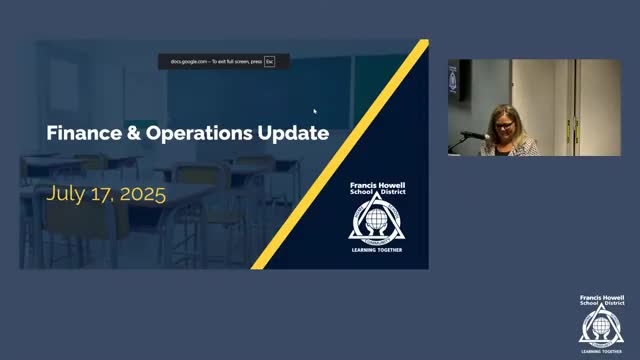
Summary
Dr. Amy St. John, deputy superintendent of finance and operations, gave the Francis Howell School District Board of Education a first update on the 2025–26 school budget on July 17 and highlighted the potential local revenue impact of recently enacted state legislation referred to as Senate Bill 3.
Dr. Amy St. John, deputy superintendent of finance and operations, gave the Francis Howell School District Board of Education a first update on the 2025–26 school budget on July 17 and highlighted the potential local revenue impact of recently enacted state legislation referred to as Senate Bill 3.
St. John told the board that the district’s unaudited expected fund balance is about 29.75 percent as the current fiscal year closes. She said the district expects to transfer unused operating funds (funds 10 and 20) to the health fund and would present final numbers next month. Bond financials include roughly $4.4 million designated from unused bond funds and a second bond phase of about $19 million to be finalized in September. Technology deployment this summer has included distribution of roughly 4,000 devices, she said.
On state policy, St. John summarized Senate Bill 3 as legislation passed in a June special session and signed by the governor on June 14 that caps the assessed value of residential primary parcels at September 2024 data. She said the district’s revenue is heavily dependent on residential property tax and that in the district’s estimate about 75.8 percent of local tax revenue comes from residential sources. Because the Hancock Amendment and other aggregate provisions still apply, St. John said the tax bill could show a credit while the district would not realize the growth in assessed valuation. Based on the district’s modeling, St. John said a reasonable estimate of the bill’s first‑year revenue effect is $4.1 million, and she warned that continued inflation would increase costs while funding growth could “flatline.”
St. John also noted the district’s self‑insurance fund required a $6 million transfer last year to remain solvent; she said a rough target reserve for the self‑insurance fund is about three months of claims (approximately $7.75 million based on a $31 million annual baseline). She said the financial audit process is underway and that a formal audit report is expected later in the fall.
Board action and next steps: the board voted to approve the finance and operations report after St. John’s presentation. A motion to approve the report was made by Director Khrushcar and seconded by Director Harmon; members voted to approve the report. St. John said staff will return with updated numbers as audits and transfers are completed and that the bond second‑phase finalization will be presented in September.
Ending: St. John urged the board and community to consider the long‑term implications of a residential AV freeze and said district staff will continue to model impacts and report back in coming months.