
Santa Cruz County justice of the peace outlines court role, DUI oversight and 12‑month recovery program
Get AI-powered insights, summaries, and transcripts
Subscribe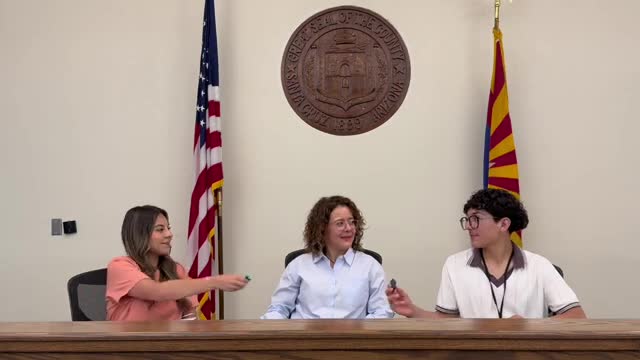
Summary
Adriana Olais, newly elected Santa Cruz County justice of the peace, described the court’s everyday duties—traffic citations, evictions and small claims—how the court enforces DUI-related conditions and a county recovery court that can lead to dismissal of charges after 12 months of compliance.
Adriana Olais, the newly elected Santa Cruz County justice of the peace, described the office’s everyday duties and programs that aim to reduce the local impact of substance abuse during a Government 101 podcast interview in Nogales.
Olais said the justice of the peace handles “the people’s court” matters such as traffic citations, evictions and small claims and enforces conditions that follow convictions, including for driving under the influence. “Justice of the peace is something you can think of it like the people's court,” she said.
The importance of that work, she said, is visible in how the court monitors compliance after a DUI conviction. Olais described routine reviews to confirm that people charged with DUIs comply with payment plans, counseling, court‑ordered community service, alcohol education and defensive driving requirements negotiated in plea agreements. “I’m just there to enforce it. It's like this. The judge is just the referee,” she said.
Olais also discussed Santa Cruz County’s recovery court, a post‑conviction program coordinated with the county attorney’s office that she said was established by Judge Velasquez. She described the program as a 12‑month, supervised treatment track that requires regular drug testing and other conditions; if a participant is enrolled, completes the program and “their lab work comes out clean,” then “at the end of those 12 months, the charge is dismissed,” Olais said, adding that dismissal means “there's no felony in your record.”
The justice of the peace position is elected; Olais said she assumed the office after campaigning across the county and began working in the court on Jan. 2. She previously worked as a court interpreter after completing state certification and said that, as a non‑attorney, one of the biggest challenges of the role is keeping up with legal vocabulary and the procedural issues that arise in court. “As a nonattorney, it's challenging sometimes to just know and stay on track and follow the law,” she said.
On public safety, Olais urged motorists to obey traffic laws, repeating a plain message to residents: “Please obey, obey, obey, obey every traffic law.” She also said substance abuse is a major local problem but emphasized that multiple agencies offer services and that the court tries to connect people to those resources rather than only punish them.
This interview was a discussion of roles and programs; no policy changes or formal court actions were announced.
Quotes in this report are taken from the podcast interview with Adriana Olais and are attributed to her as spoken.