
Architectural Review Board tables proposed addition at 237 N. Stanwood for redesign
Get AI-powered insights, summaries, and transcripts
Subscribe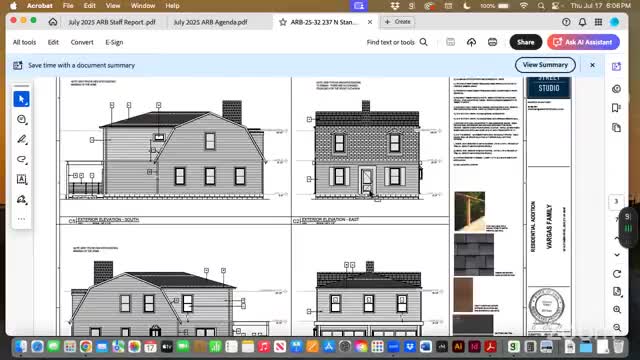
Summary
The Architecture Review Board voted to table a proposal for a 390 sq. ft. second‑floor addition at 237 North Stanwood and asked the applicant to return with revised drawings reflecting changes to roof pitch, ridgeline setbacks and fenestration.
The Architecture Review Board on July 17 tabled a proposal to add a 390‑square‑foot second‑floor addition atop a one‑story portion of the house at 237 North Stanwood and asked the applicant to return to the board with refined drawings at the Aug. 14 meeting. The applicant, Joshua Tomey, and the property owner, Alberto Largas, presented the project to the board and staff recommended more work on rooflines and windows before approval.
Karen, a staff member who presented the application, told the board she thought the addition’s placement and massing were viable but that "the devil is in the details," and recommended that the applicant return with a revision that makes the new volume "a little subservient to the original house." The board’s comments focused on lowering or clipping the new roof ridge, improving the pitch where the new roof meets the existing gambrel, and adding or reconfiguring windows on the south elevation to avoid a blank wall.
Board members echoed staff. One member said dropping the new roof eave and creating a clipped or tray ceiling within the addition would preserve interior volume while changing the exterior massing. Another asked the applicant to add architectural detail on the proposed rear pergola so it reads as an intentional element rather than an add‑on. Multiple members suggested pulling the new ridgeline down several inches and exploring dormers or other roof treatments to reduce the apparent scale from the rear.
Tomey described technical constraints, including the limitations of asphalt‑shingle pitch warranties, and said he and staff had discussed options such as a small flat portion at the ridge, using dormers for interior height, or adjusting the siding and trim to read as a sympathetic addition. He agreed to return with sketches addressing the board’s concerns.
Action taken: the board voted to table the application to the Aug. 14 meeting so the applicant can submit refined drawings. The formal motion to table passed; the transcript records the board calling for a date‑certain tabling to Aug. 14 and the motion being approved.
Why it matters: the board framed its direction around preserving the visual primacy of the original front elevation while allowing rear additions. The changes requested—roof setback, pitch adjustments, and additional windows—are the specific items staff and the board said must be resolved before the board can recommend a certificate of appropriateness.
Next steps: the applicant will consult with staff and return with revised plans for the Aug. 14 meeting. The board asked that the applicant coordinate with Karen for pre‑submission feedback.
(Ending) The application remains on the board’s active docket and will be reconsidered only after the applicant submits revised drawings addressing the board’s concerns.