
Planning commission weighs code changes to ease wildfire-hardening work while protecting historic resources
Get AI-powered insights, summaries, and transcripts
Subscribe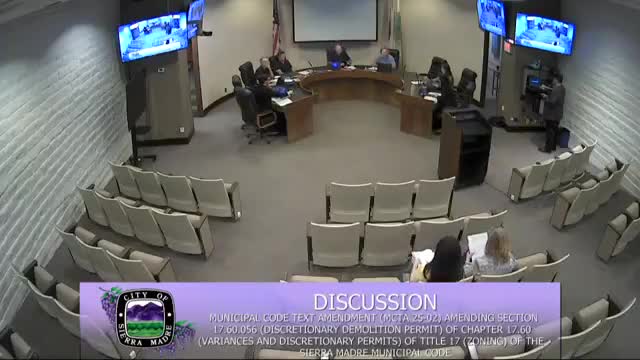
Summary
The Sierra Madre Planning Commission on July 17 reviewed a municipal-code amendment to Section 17.50.056 and related zoning provisions intended to ease delays for wildfire-hardening work on older homes while maintaining historic-preservation safeguards.
The Sierra Madre Planning Commission on July 17 reviewed a municipal-code text amendment to Section 17.50.056 and related zoning provisions that would change how discretionary demolition permits are handled for older properties, with the goal of reducing delays for wildfire-hardening work while retaining historic-preservation safeguards.
Senior Planner Wolf told the commission that the amendment responds to council direction after the Eaton Fire and a subsequent urgency ordinance. He said there is "a tension between wildfire preparation and historic preservation, which needed to be acknowledged and addressed," and staff proposed a set of exceptions, procedural clarifications and notice/timing changes to resolve many of those conflicts.
Key changes described by staff include: (1) general exceptions for work deemed necessary to further wildfire resiliency, (2) exceptions where alterations affect documented additions not original to the structure, (3) a categorical carve-out for structures built as part of residential subdivisions of five or more properties (tract developments), and (4) an operative threshold that aggregate alterations not exceed 10% of the property’s improvement value to qualify for the exception. Staff also proposes codifying current administrative practice, clarifying noticing for administrative reviews (including a property posting), and options to reduce or waive the traditional 30‑day wait period for demolition permits when justified by building-official findings or when a discretionary demolition permit is approved.
Planner Wolf explained the logistics of the existing review: when a homeowner proposes exterior changes (for example, window replacement), an historic assessment from the sole-source historian can take about three weeks, and administrative noticing can add another two weeks so the combined process may take roughly five weeks. To reduce that delay for wildfire-hardening work, staff proposed director-level guidelines that would allow ministerial approval for specified low-impact changes and a short appeal channel to preserve community oversight.
Commissioners debated additional options including whether the 75-year threshold for discretionary review should be revised (alternatives discussed included 1940 or 1945 as cutoffs), how to structure a ministerial-review guideline and a short appeal process, and whether to require a bond or fee if a neighbor appeals to force a full historic review. Leslie Ziff, vice president of the Sierra Madre Historical Society, asked the commission to consider specific deteriorating designated structures — McCumber Cabin and Carter Barn — during deliberations.
The commission formed a two-member subcommittee (Chair Denison and Commissioner Brennan) to work with staff on ministerial-review guidelines, an appeals procedure and any proposed year-based cutoff; staff requested subcommittee input by July 31 and indicated the next public hearing on the code amendment is scheduled for August 7. Staff also offered to supply data showing the distribution of home construction years to help the commission select a date if it chooses a year-based carve-out.