
Treasurer warns state budget vetoes and forecast changes could affect Marysville finances
Get AI-powered insights, summaries, and transcripts
Subscribe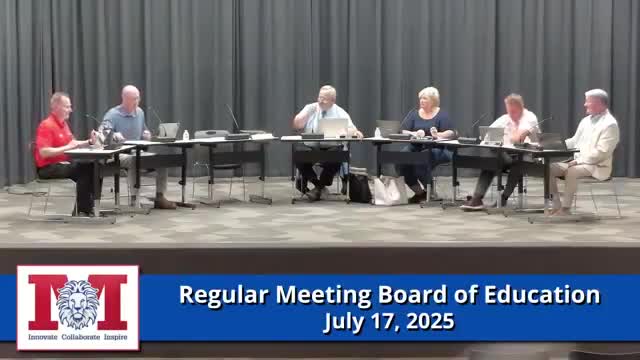
Summary
Treasurer Todd Johnson told the Marysville school board on July 17 that recent state budget actions and a forthcoming change from a five‑year to a four‑year forecasting schedule will affect long‑range revenue projections and planning.
Treasurer Todd Johnson told the Marysville Exempted Village School District Board of Education on July 17 that the recently signed state biennial budget contains vetoes the district viewed favorably but that several pending legislative moves and a change in forecasting deadlines could materially affect future revenue projections.
Johnson said the governor vetoed several items the district welcomed, including a provision that would have allowed county budget commissions to reduce school millage and a proposal that would have altered how emergency levies are counted in the 20‑mill floor calculation. He also noted the state will change the required forecast schedule from a five‑year outlook to a four‑year outlook; for the district the October forecast deadline will be October 15 and May updates will move to February 28 with thereafter an August/February cadence.
The treasurer reported fiscal year 2025 actual totals now available: total revenue about $8.3 million, with real estate tax the largest portion at just over $4 million and TIF (tax increment financing) revenue somewhat above $3 million for fiscal 25. Johnson warned the TIF amount will drop in future years and that the district adjusted PI (Permanent Improvement) and general fund plans this year anticipating the change. He said that, overall, revenue and expenditures for the fiscal year came in within a fraction of projected amounts.
Johnson also reviewed capital and facilities needs identified by the district’s consultant, citing large multi‑year items such as mechanical systems (estimated about $6.2 million over five years), roofing, asphalt (about $3.2 million), fire panels and chillers, and other urgent items. He said many of those urgent maintenance items can be done within the current forecast, but the long‑term picture depends on the master facilities plan and any future bond proposal. The treasurer reported the bond fund currently has $5.3 million and that after four more years of debt payments the district’s existing bonds would be paid off (December 2028 payment noted as payoff date), making a potential “no new millage” bond issue possible in a future cycle.
Johnson also warned of a potential federal funding reduction: preliminary guidance from the Ohio Department of Education indicated that Title II‑A and Title IV‑A funds (about $100,000 and $30,000 respectively in past years) should not be expected this year, which would shift that previously earmarked staff cost back into the general fund if the guidance is finalized.
Board members discussed the implications: moving from a five‑year to a four‑year forecast will compress and potentially improve the appearance of long‑term forecasts (because the most difficult year previously was year five), but it does not remove underlying fiscal pressures. Johnson said the district would still run internal five‑year analyses for planning but that state reporting will now use four years. The treasurer concluded that the district is in a relatively stable short‑term position but that timing of projects and the recommended facilities plan will determine longer‑term outcomes.
Johnson’s presentation included line‑item detail on fiscal 25 expenditures (transportation purchases, technology refresh, gym repairs, HVAC work), an urgent list from the facilities consultant (HPM), and a projection showing cash balance increases for fiscal 25 and 26 before future projects are completed. He said the district should be able to address currently identified urgent work within the forecast but that the ultimate mix of PI fund spending versus bond funding will depend on the facilities plan and community decisions about a future levy or bond.
Quoted material is taken from Treasurer Todd Johnson’s July 17 presentation and board discussion at that meeting.