Get Full Government Meeting Transcripts, Videos, & Alerts Forever!
Get email alerts on the Federal Bill Hr1 topic
No spam. Unsubscribe anytime.
Seattle staff warn HR1 will cut Medicaid, SNAP and other safety-net funding and shift costs to states
Summary
Seattle City Council committee members were warned July 18 that H.R.1, described in the meeting as the “1 Big Beautiful Act,” will reduce federal health and nutrition benefits, raise administrative costs for states and local governments and produce sizable local budget shortfalls if departments and partners do not act.
Seattle City Council committee members were warned July 18 that H.R.1, described in the meeting as the “1 Big Beautiful Act,” will reduce federal health and nutrition benefits, raise administrative costs for states and local governments and produce sizable local budget shortfalls if departments and partners do not act.
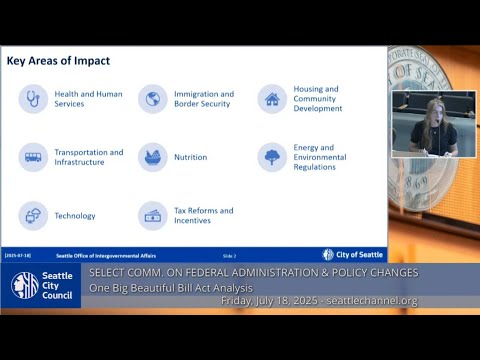
Annie, a staff member from the City Office of Intergovernmental Relations, told the Select Committee on Federal Administration and Policy Changes that the reconciliation package signed July 4 spans nearly 900 pages and includes major changes to Medicaid, the Children’s Health Insurance Program, SNAP and immigration-related programs. She said the package uses reconciliation rules to pass with a simple majority and folded measures from roughly 10 congressional committees into one bill.
The committee heard that the city expects a range of direct and indirect local effects. On health services, OIR highlighted phased reductions to Medicaid and children’s coverage beginning in 2027, changes to work requirements and cost sharing, and provisions that would bar or limit enrollment for some noncitizen groups. The office also cited explicit federal restrictions in the bill on funding to certain providers for family planning and abortion-related services and related preventive care such as STI testing and contraception.
OIR estimated the bill could remove health coverage from roughly 330,000 Washington residents and cause an estimated $6.6 billion loss to the state’s hospital system over the next decade. The presentation named specific local impacts: an estimated $56 million in loss to Harborview Medical Center, about $45 million to the University of Washington Medical Center, nearly $30 million to Swedish Medical Center, and about $12 million to Virginia Mason Medical Center. Annie said departments are still analyzing the detailed fiscal impacts and will follow up with additional findings.
On immigration and border enforcement, OIR said the bill increases fees for asylum and temporary status applications, allocates significant new funding for DHS, DOJ and ICE, and provides roughly $625 million for host-city security around the FIFA World Cup; Seattle’s portion was estimated at about $31 million. Staff said that funding would likely flow through the Department of Homeland Security and local organizing partners, and that city officials are coordinating with the mayor’s office and FIFA teams on receipt and administration of those dollars.
On housing, the presentation said the bill expands Low-Income Housing Tax Credit rules and the opportunity zones program, includes new provisions focused on rural areas, and retained the municipal bond tax-exempt status used to finance large infrastructure projects. On nutrition, OIR flagged large SNAP cuts and program changes, including an estimate of roughly $186 billion in nationwide SNAP reductions, a projected Washington state share near $90 million in shifted costs, and benefit reductions that would lower an example family-of-four’s monthly allotment from $975 to $848 in some scenarios.
Council members asked staff to coordinate closely with county public health, the state and human services departments to assess impacts to behavioral health, elder services and services for people with disabilities. Council President Nelson and others urged immediate work to help residents who may need disability verifications or other documentation to maintain benefits under new rules. Several council members said the city must explore options to backfill harmed services through the budget and partner with the county and state.
OIR repeatedly characterized the picture as preliminary and said more departmental analyses and follow-up conversations are forthcoming. The office pledged to continue outreach to public health, Human Services Department partners, and state contacts to refine estimates and to return with additional detail.
Why it matters: The changes described would reduce federal outlays for health, housing and nutrition programs and shift administrative costs to states and localities, potentially increasing demand for city and nonprofit services. City staff and council members said prompt coordination is needed so Seattle can mitigate disruptions, preserve services and help residents complete eligibility and verification processes.
The committee took no formal vote on policy changes during the briefing; staff were asked to report back with additional analysis and coordination plans.