Get Full Government Meeting Transcripts, Videos, & Alerts Forever!
Get email alerts on the Telecommunications Tower topic
No spam. Unsubscribe anytime.
Zoning committee denies 250-foot Edgewater cellphone tower after town rejection, colocation gaps
Summary
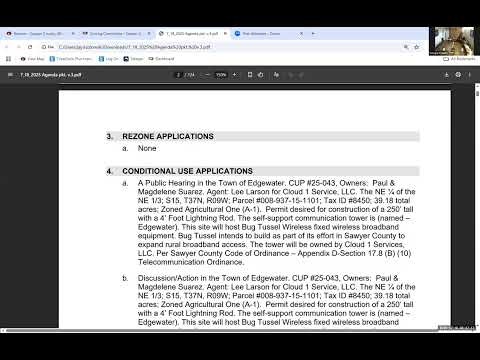
Sawyer County Zoning Committee voted to deny a conditional use permit for a proposed 250-foot telecommunication tower in the town of Edgewater, citing the town's prior denial, incomplete colocation analysis and public concerns about lighting and process.
The Sawyer County Zoning Committee voted unanimously to deny a conditional use permit for a proposed 250-foot telecommunications tower on land owned by Paul and Magdalene Suarez in the town of Edgewater. The committee based its decision on the town board's prior denial, the applicant’s incomplete colocation/search-ring analysis under Wisconsin Statutes 66.0404, and concerns raised during public comment about lighting and public process. The denial matters because counties and towns are wrestling with how state law on mobile tower siting interacts with local review. The committee's decision prevents CloudOne Services LLC (which proposed the tower and would own the structure) and broadband provider BugTussle from constructing at the Suarez site until the applicant addresses the outstanding technical and procedural questions. Jay, the county zoning administrator, told the committee that CloudOne had applied for a 250-foot self-supporting tower with a 4-foot lightning rod to host BugTussle fixed‑wireless broadband equipment and that the application was initially deemed “complete.” Jay also said an operational 400-foot tower about 2.2 miles from the proposed site was not included in the applicant’s search‑ring materials and therefore had not been considered for colocation in the applicant’s RF affidavit. Public commenters urged denial. Linda Zilmer, an Edgewater property owner, asked for clearer procedures and said the county’s telecommunications ordinance is “largely outdated and invalid.” A pair of nearby residents, Randy and Carol Hagen, submitted a written objection that the tower would be an eyesore and expressed health and safety concerns. John Dalton, who identified himself as a telecommunications engineer, recommended the applicant rework the colocation analysis and suggested a compromise of reducing tower height under 200 feet to avoid lighting requirements. Rebecca, the county corporation counsel, advised the committee on statutory limits and the interaction between the county’s telecommunication ordinance and state law. She said portions of the county ordinance are preempted by state statute but that some local provisions (including an existing county provision calling for town approval) still apply, and she recommended requiring the applicant to complete a colocation feasibility analysis now that a new nearby tower exists. The committee’s motion cited substantial evidence for denial: (1) the town board had denied the CUP, (2) the applicant’s search‑ring and colocation analysis did not account for the nearby 400‑foot tower, and (3) concerns about lighting/visual impacts were added to the motion as part of the committee’s findings. The motion also waived the standard one‑year refiling restriction so the applicant could reapply sooner if it addressed the issues. The motion passed on a roll‑call vote with all five voting members recorded as yes. What the decision does — and does not — do: it denies the present CUP application. The denial was based on procedural and evidentiary gaps in the application and on the town’s denial; it is not a ruling on technical radio coverage or on RF health claims. Committee members and counsel noted that state law limits the county’s regulatory reach on health issues and that statutory protections require the applicant to provide a sworn colocation statement if it contests feasibility findings. Next steps: the applicant may refile after completing the colocation feasibility work and addressing the town’s concerns. The county can require more information in any reapplication and will not sign off on a tower permit until the committee’s evidentiary concerns are resolved.