
Committee leaves delegation of council‑chamber approvals unresolved after debate over chairman, ADA and policy
Get AI-powered insights, summaries, and transcripts
Subscribe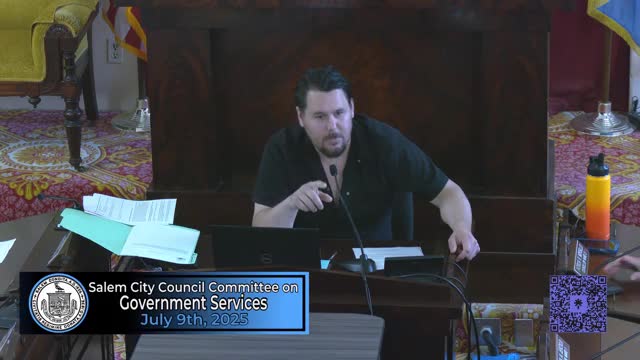
Summary
Committee debated an order to delegate approval for use of the City Council Chambers to the city clerk with the council president's concurrence; members split on whether to adopt a temporary fix or wait for a written policy, and the motion to act failed, leaving the matter in committee.
Committee on Government Services co‑posted with the Committee of the Whole — Salem, July 9, 2025 — Committee members debated whether to change current practices so the city clerk, with the approval of the City Council president, could approve use of the City Council Chambers and anteroom without a full council vote.
Supporters said the change, proposed in language drafted by the city solicitor, would provide a short‑term check and balance while a broader written policy is developed; opponents said the council should not alter the ordinance absent the city solicitor’s presence and argued the council president should simply ask the clerk to consult before approving events. After discussion the committee voted; motions to either keep the matter in committee or to send a positive recommendation tied, and the order therefore remained in committee.
Members discussed several issues raised by past event requests. Committee members said two recent requests — a Polish‑American flag‑raising and an event organized by an AAPI group — had been directed away from the council chambers when the clerk cited compliance and procedural concerns. Some members said the clerk had cited ADA access concerns; others said the clerk’s hesitation was about whether approving some events would obligate the council to approve many types of outside uses without a clear policy.
Councilor Presniewski said he was “a little bit confused” and said the city solicitor should be present for the discussion. Councilors Marcela and Merkel said they wanted the solicitor and the absent councilor who had first sent the order to committee (Councilor Stott) to be present before the committee acts. Proponents, including the motion’s sponsor, argued a temporary delegation requiring the city clerk to confer with the council president would prevent last‑minute denials and allow reasonably vetted events to proceed while the council develops a formal policy.
Under discussion vs. decision: the committee engaged in extended discussion about procedure, ADA compliance (referenced by the city’s ADA director), and respect for members who requested the item be sent to committee. The committee did not adopt the solicitor’s proposed two‑sentence order; a motion to keep the item in committee and a later motion to send the order to council with a positive recommendation each failed to obtain a majority, and the matter remains in committee for further work.
Next steps: the item remains in committee; committee members requested further review and the presence of the city solicitor and city clerk for future discussion and to assist drafting a formal policy for chamber use.