Get Full Government Meeting Transcripts, Videos, & Alerts Forever!
Get email alerts on the Parking Minimums topic
No spam. Unsubscribe anytime.
Residents press Salem council to remove minimum parking rules; council refers zoning changes to planning board
Summary
Public commenters urged removing minimum parking requirements for new multifamily housing to free up land for housing and reduce costs. Councilor Hapworth referred a zoning amendment on parking minimums to the Planning Board for a joint public hearing.
Three members of the public urged the Salem City Council on July 17 to reduce or eliminate minimum parking requirements for new multifamily housing, saying the rules add cost, encourage car dependency and waste land that could become housing.
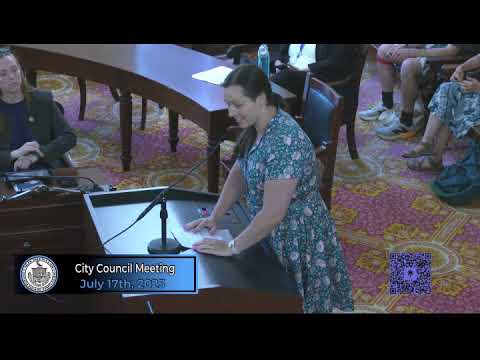
Kaitlin Halapa, a resident of Ward 6, told the council she supports ‘‘removing minimum parking requirements’’ and criticized the city’s rule that requires 1.5 spaces per unit for new multifamily developments regardless of unit affordability, location or resident demographics. She pointed to a city parking study she said counted the equivalent of 870 parking spaces across 14 developments and said the city ‘‘could build 436 housing units in that space.’’
Lydia King, another resident, told the council she lived in one of the studied complexes and observed roughly 40% of spaces empty overnight; she also raised concerns about temporary needs such as short-term parking for home-health aides.
Councilor Hapworth moved to refer a proposed zoning amendment on parking minimums to the Planning Board for a joint public hearing, which the council approved. Council discussion cited national research and local stormwater/heat-island concerns related to overbuilt surface parking. Hapworth recommended Donald Shoup’s book The High Cost of Free Parking as background reading.
Supporters said eliminating or reducing minimum parking would lower housing costs and allow infill development on already-paved lots. Councilors voiced the need for further public engagement and technical review; the referral to the Planning Board will open a formal joint public-review process before any ordinance change.
The referral means the Planning Board will hold a joint public hearing with the City Council in the zoning amendment process; no zoning change was adopted at the July 17 meeting.