
Tampa council denies request to vacate Cordelia Street alley after code and flooding concerns
Get AI-powered insights, summaries, and transcripts
Subscribe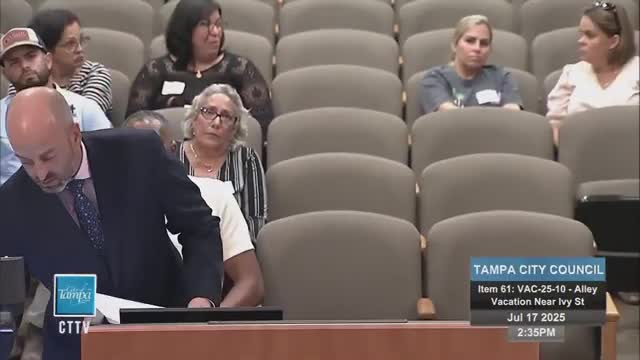
Summary
The council voted to deny a petition to vacate a 10-foot alley at 3203 West Cordelia Street after staff flagged code violations, utility easements and residents raised flooding and public-safety concerns.
The Tampa City Council voted to deny a petition to vacate the 10-foot alley that runs north of Cordelia Street and south of Ivy Street in West Tampa, citing code violations, utility easements and concerns that closing the alley could worsen localized flooding. The motion to deny passed after a roll-call vote; Councilman Juan Miranda was the lone dissenting vote.
City staff had recommended against the vacation. Abby Feeley, director of Development and Economic Opportunity, and departments including Wastewater, Code Enforcement, Mobility and Natural Resources raised objections and asked that standard easement reservations be retained for utilities. Code Enforcement officer Jean Primus told the council she had an active case documenting “obstructions that they have placed in the alley,” including paving, gates and an outdoor kitchen, and said building-permit and work-without-permit enforcement is underway.
The council heard competing testimony. Victor Molina Rodriguez, who presented on behalf of his mother-in-law, said neighbors maintain portions of the alley and asked that the council allow vacation while reserving utility access. Neighbors and an adjacent property owner said the alley’s current condition has led to debris, unauthorized occupation and public-safety incidents. One neighbor, Daniel Weldon, testifying during a different vacation earlier in the meeting, described vagrant activity and animal infestations tied to an adjacent, vacant house; in the Cordelia item neighbors identified alleged obstructions and standing water problems.
Legal staff and mobility personnel told the council that vacating the city’s right-of-way interest would not extinguish existing utility easements and that easement rights would remain; however, several council members said that once the city relinquishes its right-of-way interest, enforcement of encroachments could shift from code enforcement to private parties and utility owners, making remedy more difficult.
Council discussion focused on two policy points: whether the alley serves a present or future public purpose for access and stormwater, and the propriety of vacating rights where extensive private encroachments already exist. Members raised broader policy concerns about preserving alleys for long-term infrastructure and neighborhood resilience. Councilwoman Michelle Hertek moved to deny the vacation, citing lack of sufficient public-benefit findings and staff objections. The motion carried on roll call; Miranda voted no.
The council’s action was a legislative denial of the vacation request; staff advised property owners that any after-the-fact building and permit issues remain subject to code enforcement independent of the vacation decision.
The denial leaves the city’s right-of-way interest intact and keeps the alley subject to existing utility easements and municipal code enforcement. Council members requested a written staff report on related matters that emerged during the hearing, including stormwater and enforcement pathways for right-of-way encroachments.