Get Full Government Meeting Transcripts, Videos, & Alerts Forever!
Get email alerts on the Ambulance Service Funding topic
No spam. Unsubscribe anytime.
International Falls council sets Dec. 31 deadline to resolve ambulance fund shortfall, forms outreach committee
Summary
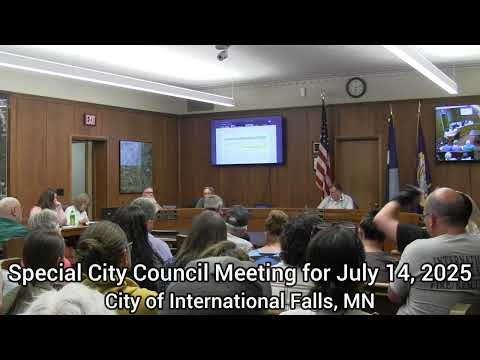
The International Falls City Council on July 14 set a Dec. 31 deadline to secure outside support or make changes to its Advanced Life Support ambulance service, unanimously approved a committee to contact affected jurisdictions and agreed to weekly progress meetings.
The International Falls City Council voted unanimously July 14 to set a Dec. 31 deadline for finding a funding solution for the city ambulance service, to form a committee to reach out to other political subdivisions about a possible ambulance taxing district, and to hold weekly Council-of-the-Whole updates on the issue.
The deadline motion, introduced by Councilor Pete Kaler and seconded by Councilor Buller, passed 5-0. Mayor Dill then moved and the council approved formation of a committee, and the council also voted unanimously to hold weekly meetings for updates from Chief Manasseh, Administrator Bergstrom and Finance Officer Rudd.
The action follows an auditor letter presented to the council that warned rising cash advances from the city's general fund to the ambulance fund have been recorded as loans but “may no longer be representative of true facts and circumstances,” and that auditors could require either permanent cash transfers to the ambulance fund or a modified audit opinion if the city does not address the deficit. Mayor Dill read portions of that letter during the meeting: “Due to recurring operational deficits in the City's Ambulance Fund, the amount of cash being borrowed from the City's general fund to the Ambulance Fund has grown significantly over recent years.”
Why it matters: Council members and resident speakers said the city's part-time Advanced Life Support (ALS) system has saved lives but is running persistent annual deficits the city cannot sustain without outside help or large tax increases. The council and public discussed three broad options that have surfaced in past reviews: (1) create an ambulance taxing district shared with Koochiching County and neighboring jurisdictions; (2) cut service level to a Basic Life Support (BLS) model; or (3) raise city taxes to fund continuing ALS operations.
Discussion and motions Councilor Kaler urged a deadline so talks would not “go for years,” and proposed Dec. 31 as the cut-off. The motion passed unanimously with five affirmative votes recorded. Mayor Dill then asked the council to form a committee to reach out to “all political subdivisions that a district could affect.” The council approved the committee motion; Mayor Dill stated she intended the committee to include Councilor Kaler and Councilor Holden to contact county and neighboring-city officials.
The council also approved a recurring Council-of-the-Whole meeting every Monday immediately after other posted council meetings, with a standing 5:30 p.m. start time on Mondays when no other council meeting was scheduled. Those meetings are intended to receive weekly updates from Chief Manasseh, Administrator Bergstrom and Finance Officer Rudd.
Options on the table and financial context Mayor Dill and councilors walked through the service history: the ambulance certificate moved from the hospital to the city, the service transitioned to an ALS model about 2012, and audited fund balances show the ambulance operation has run in the red for several years. In remarks to the council, Mayor Dill said the ambulance fund’s debt to the general fund has no current ability to be repaid and the city’s general fund also lacks cash to make permanent transfers.
Speakers discussed Local Government Aid (LGA) and state assistance. Mayor Wagner of Rainier, who attended as an elected official from a neighboring city, argued that LGA is a formula meant to support hub-city services and said International Falls receives roughly $4,937,482 in LGA while Rainier receives about $68,000. City staff and others clarified that LGA documentation does not require cities to use the funds for ambulance service.
At the state level, meeting participants referred to an operating-deficit appropriation passed in the recent legislative session—described in the meeting as about $8.2 million—that will be divided among ambulance services that submit reports verifying operating losses after fiscal year 2026. Chief Manasseh said those funds might be available to help repay loans if International Falls files and qualifies.
Public comment and operational details Dozens of residents and current and former ambulance personnel urged the council to preserve ALS. Former committee members and current responders stressed the difference in care between ALS paramedic response and BLS EMT response: “Without that, who’s gonna get you there? Time is money. Time is death,” said Sarah Arch, a registered nurse who works at the local hospital.
Former committee members and outside ambulance leaders recommended pursuing a taxing district that would spread costs across the service area; Cassie, who identified herself as leadership at Baudette / Lake of the Woods Ambulance, estimated the city has lost about $1.1 million in transfer revenue since 2021 and urged inclusion of townships and countywide participants in a taxing district.
Staff and council members also described operational pressures: the service currently runs with fewer paramedics than historically (Councilors and staff said the paramedic complement fell from six to four), the fleet is aged and under heavy mileage, and the city has three ambulance orders outstanding. Chief Manasseh and others explained ambulances can cost roughly $300,000 for the chassis and substantially more once equipment is installed, and lead times for new rigs can be multiple years.
Audit choices and next steps The city auditor’s letter presented two alternatives if the city cannot correct the accounting and funding situation: record permanent cash transfers into the ambulance fund (sourced from the general fund or other funds at council discretion) or accept a modified audit opinion that discloses the borrowings and their impact. Mayor Dill said staff have contacted state legislators to ask what would happen if the city allowed its ambulance certificate to lapse, but had not yet received a definitive answer on state takeover or certificate reassignment.
The council’s immediate directives: (1) set a Dec. 31 deadline to secure external support or enact a new funding approach; (2) form a committee to contact Koochiching County, the city of Rainier and other political subdivisions; and (3) hold weekly Council-of-the-Whole updates to track progress. The committee and weekly meetings are intended to produce a report and recommendations before the end-of-year deadline.
Votes at a glance - Motion to set Dec. 31 deadline for securing funding or changing service model: moved by Councilor Pete Kaler; seconded by Councilor Buller; vote: unanimous (5-0); outcome: approved. - Motion to form a committee to contact potentially affected political subdivisions: moved by Councilor Boehrer; seconded by Councilor Wagner; vote: unanimous; outcome: approved. - Motion to hold weekly Council-of-the-Whole updates with standing staff reports (5:30 p.m. when no other meeting posted): moved by Councilor Kaler; seconded by Councilor Buller; vote: unanimous; outcome: approved.
What’s next The newly approved committee is to begin outreach to Koochiching County, the city of Rainier, and other political subdivisions that would be included in a taxing district; weekly meetings will provide staff updates. Council members said they want a tangible plan before Dec. 31—whether that plan is a taxing district, a tax-levy increase, operational changes to staffing/scheduling, or a move back to BLS—but noted that failing to reach a viable solution could force the council to reduce service or seek substantial new city revenue.
Community members who addressed the council urged residents who receive the ambulance service to press county and neighboring-city officials to participate in any taxing district; others emphasized protecting ALS because of its role in pre-hospital critical care and transfers to regional trauma centers.